
Before the Lunar Economy, the Infrastructure That Must Exist on the Moon
Surface and Subsurface Systems Required for Early Lunar Operations
Most discussions about returning to the Moon focus on rockets, landers, and astronauts. These systems solve the transportation problem. They deliver payloads to the lunar surface, but they do not create an operating environment. Sustained activity on the Moon will depend on something far less visible: infrastructure interacting with the ground. Every landing, rover movement, excavation system, power plant, and habitat ultimately transfers loads to the lunar surface. Yet the mechanical behavior of that surface under operational conditions remains largely unexplored. Before any lunar economy can emerge, the Moon will require a capability that is still missing today: the ability to prepare, stabilize, and build on the ground.

The Moon Has Transportation Systems, Not Infrastructure
We know how to reach the Moon. We still do not know how to operate on it.
Launch vehicles, transfer stages, and landers are solving the transportation problem. Over the last decade, the industry has invested enormous effort into this layer of the architecture. NASA’s Artemis program, commercial landers under CLPS, and heavy transport systems under development by SpaceX and Blue Origin are all focused on delivering payloads safely to the lunar surface. This is an essential step, but it does not yet constitute an operating environment.
Infrastructure begins when activities can repeat with predictable performance. It requires stable ground conditions, controlled operating zones, and systems designed to interact reliably with the surface. None of these elements currently exists on the Moon.
Every operational system ultimately transfers load to the ground. Landing vehicles impose concentrated stresses during touchdown and plume interaction during descent. Rovers depend on the traction and bearing response of the surface. Excavation systems must overcome penetration resistance and particle interlocking. Power systems, communication nodes, and habitats require stable foundations. The lunar surface is therefore not a passive background. It is the structural platform on which the entire architecture depends.
Current mission architectures largely treat the ground as a boundary condition rather than a system that must be engineered. This assumption is convenient during early exploration phases, but it becomes increasingly fragile as payload mass increases and operations become more frequent. Larger landers, repeated descents, and surface logistics will impose mechanical disturbances on regolith that has remained largely undisturbed for geological timescales.
The distinction between transportation and infrastructure will become clear as soon as sustained operations begin. Delivering hardware to the surface is only the first step. Maintaining stable landing zones, supporting vehicle mobility, protecting equipment from dust mobilization, and constructing protected installations will require deliberate modification of the ground environment.
The Moon today has access systems. What it does not yet have is the infrastructure required to support continuous activity on its surface. The transition between these two phases will define the practical beginning of the lunar economy.
Landing Without Prepared Ground Is Not a Strategy
Rocket plumes interacting with regolith will become one of the first operational constraints on the Moon. During descent, exhaust gases accelerate across the surface and mobilize particles with significant velocity. Even modest thrust levels during the Apollo missions produced visible erosion beneath landing engines. Future systems will operate at far greater thrust levels and with much heavier payloads. The interaction between plume flow and loose granular material will disturb the surface, excavate shallow craters, and eject particles over considerable distances.
This effect is not merely cosmetic. Ejected particles can damage nearby equipment, contaminate mechanical systems, and degrade optical surfaces. As the number of landings increases, the same terrain will experience repeated disturbance, progressively modifying its surface structure.

Repeated landing operations, therefore, introduce a new requirement: stable landing zones.
On Earth, airports are built before air traffic becomes routine. The lunar equivalent will likely involve surface preparation techniques such as compaction, grading, sintering, or berm construction to control particle transport and protect nearby assets. Without these measures, landing operations will impose unacceptable risk to surface infrastructure.
The First Construction Activity Will Be Moving Regolith
Early lunar construction will not begin with buildings. It will begin with earthmoving. Regolith will serve simultaneously as an obstacle, foundation material, shielding medium, and construction resource. Before any permanent installation is placed on the surface, the terrain itself must be reshaped to support operations.
Surface preparation may include grading landing areas, constructing berms to intercept ejecta, redistributing material to stabilize traffic routes, and placing regolith layers over equipment for radiation shielding. Each of these activities requires excavation and bulk material handling.
This introduces a set of engineering questions that have received limited attention so far. Penetration resistance governs excavation productivity. Particle angularity affects cutting tool wear. Bulk density controls the stability of constructed berms and shielding layers. Equipment performance will depend on how these mechanical properties vary across the site.
In practical terms, the first large-scale mechanical activity on the Moon will likely resemble a civil construction site rather than a laboratory experiment.
The Subsurface Will Become Valuable Quickly
Radiation exposure, micrometeoroid impacts, and large thermal cycles create conditions that challenge long-term surface installations. Equipment placed directly on the surface must withstand temperature variations exceeding hundreds of degrees and continuous exposure to energetic particles. The subsurface offers a more stable environment.
Even shallow burial beneath regolith can significantly reduce radiation exposure and dampen temperature fluctuations. Regolith layers also protect against micrometeoroid impacts. For these reasons, partially buried or underground infrastructure may become attractive earlier than commonly assumed.

Creating such environments requires excavation or trenching operations and controlled placement of regolith around structural systems. Access tunnels, covered trenches, or berm-protected installations could appear during early phases of lunar development.
Surface structures may dominate architectural concepts, but practical engineering solutions will likely incorporate the subsurface from the beginning.
The Lunar Economy Begins with Ground Engineering
The concept of a lunar economy is often framed in terms of launch costs, resource extraction, or transportation logistics.
Those factors matter. None of them operates independently from the ground.
Economic activity requires repeatable operations. Repeatable operations require stable infrastructure. Stable infrastructure requires predictable interaction with the ground supporting it.
Landing systems, excavation machines, surface mobility networks, energy installations, and protected habitats all depend on how loads are transmitted through regolith and how that material responds to disturbance. These are not peripheral details. They are the mechanical foundation of sustained activity on the Moon.
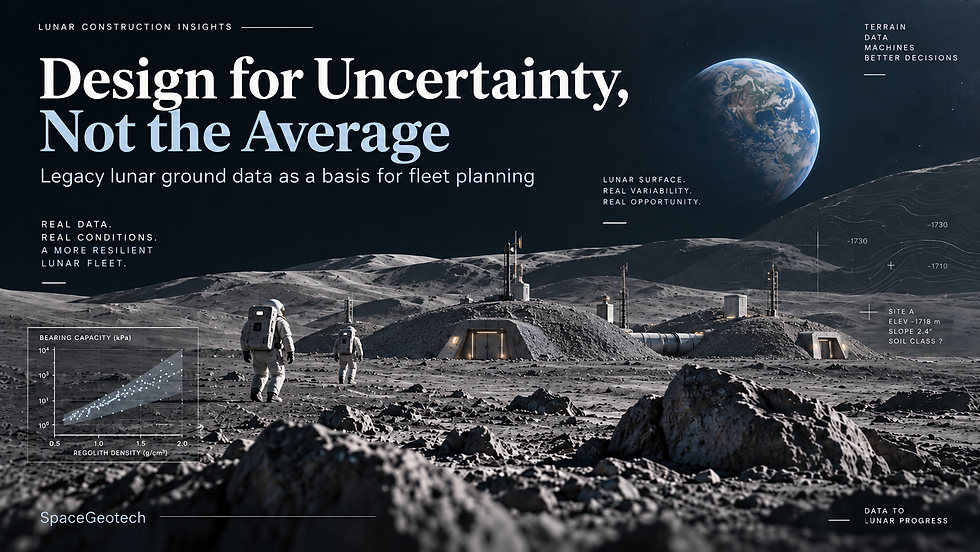
At present, engineering knowledge of lunar ground behavior remains limited. Apollo missions provided valuable observations, but they were never designed as geotechnical site investigations. Modern mission architectures assume surface operations will occur successfully, yet the mechanical conditions controlling those operations remain poorly constrained.
Before the lunar economy can scale, this gap will need to be addressed. The transition from exploration to infrastructure will not be defined by rockets.
It will be defined by how well we learn to engineer the ground beneath them.
What the Moon Still Lacks
Plans for lunar activity are advancing quickly. Heavy landers, power systems, cargo logistics, and surface missions are being designed across government and commercial programs. What remains largely absent from these plans is the type of ground investigation that precedes every major construction project on Earth.
Civil infrastructure is never deployed without understanding the material that will support it. Foundations are not designed without bearing capacity. Excavation equipment is not selected without knowing the penetration resistance. Roads are not built without considering traffic loads and surface degradation.
On the Moon, those parameters remain uncertain.
The Apollo missions provided observations from a handful of landing sites. Those data points are invaluable, but they represent isolated measurements gathered under scientific objectives. They do not constitute a systematic geotechnical characterization of the lunar surface.
The next phase of lunar development will require a different type of mission. Not exploration in the traditional sense, but investigation aimed at understanding how the ground behaves under operational loads. Penetration testing, excavation trials, surface stabilization experiments, and repeated landing effects must be measured directly.
The lunar economy will not be constrained by launch vehicles or orbital mechanics. It will be constrained by the surface on which all operations depend. Whoever understands that surface first will shape how the next phase of lunar development unfolds.
Roberto Moraes
SpaceGeotech Founder
The views and technical opinions expressed in this article are solely those of the author. They do not represent the positions, policies, or endorsements of the author’s employer or any affiliated organization.


Comments