
Construction Readiness Framework for Lunar Infrastructure Delivery
A structured framework for assessing the readiness of site conditions, construction methods, logistics, execution systems, and infrastructure integration for lunar deployment

Concept and Scope
The Construction Readiness Framework (CRF) is proposed as a structured basis for evaluating whether lunar infrastructure can be delivered with sufficient reliability under the combined constraints of environment, ground conditions, and operational systems. The framework is not derived from, nor intended to compete with, Technology Readiness Levels. It addresses a different problem. Technology readiness evaluates whether a component or system can function. Construction readiness evaluates whether infrastructure can be built, integrated, and sustained in a given environment.
Infrastructure delivery is governed by factors that are external to the technology itself, including the behavior of the ground, the interaction between equipment and regolith, the sequencing and logistics of construction operations, and the integration of systems under conditions that cannot be fully replicated on Earth. Existing maturity frameworks do not resolve these aspects, particularly where performance depends on site-specific conditions and system-level coupling.
The CRF is therefore framed around the premise that construction is a system-of-systems problem anchored in the ground, not a linear progression of technology validation.
1.1. Framework Definition
Construction readiness is defined as the degree to which a lunar infrastructure system can be executed from initial ground interaction through to operational integration, with controlled uncertainty in performance, cost, and schedule.
The framework is structured around five coupled dimensions that must be considered simultaneously: ground conditions, construction methods, logistics, execution systems, and infrastructure integration. These are not independent categories. They represent interacting components of a single delivery system, where deficiencies in one domain propagate directly into others.
1.2. Ground Conditions as the Primary Constraint
Any construction framework for the Moon must begin with the ground. The regolith is not a passive medium. It governs bearing response, excavation energy, mobility, dust generation, and long-term stability. Its behavior is controlled by low confinement, stress history, particle morphology, and the absence of pore fluids. These conditions produce mechanical responses that are not directly analogous to terrestrial soils.
A key requirement of construction readiness is therefore the ability to interpret and bound ground behavior at the scale relevant to construction activities. This includes near-surface response controlling mobility and excavation, as well as deeper conditions governing foundation performance and structural interaction. Without this, design assumptions remain unverified, and construction becomes a trial process rather than an engineered operation.
Its behavior is controlled by low confinement, stress history, particle morphology, and the absence of pore fluids (Heiken et al., 1991; Mitchell et al., 1974).
The framework explicitly requires that ground conditions are not treated as background data, but as a governing parameter in construction feasibility.
1.3. Construction Methods and Buildability
Construction readiness requires that proposed methods are compatible with the ground and environmental conditions in which they are applied. Methods developed under terrestrial assumptions, particularly those relying on confinement, moisture, or conventional material behavior, cannot be directly transferred.
Buildability must be demonstrated in terms of excavation response, material handling, compaction or bonding mechanisms, and achievable tolerances. The absence of water, reduced gravity, and thermal extremes impose constraints that affect not only material performance but also the sequence and controllability of construction operations.
The framework therefore evaluates whether infrastructure can be physically realized using methods that are consistent with both the ground state and the operational environment, rather than whether the methods are theoretically feasible.
1.4. Logistics as a Controlling Boundary Condition
Unlike terrestrial projects, lunar construction is bounded by strict logistical constraints. Mass, energy availability, deployment sequence, and maintenance capacity are not secondary considerations; they define the feasible solution space.
Construction readiness requires that the entire delivery chain, from equipment deployment to material sourcing and operational sequencing, is coherent and sustainable. This includes the balance between imported systems and in-situ resource utilization, the impact of energy cycles on construction progress, and the ability to maintain and adapt systems over time.
A method that is technically viable but logistically unsustainable is not considered constructible within the framework.
1.5. Execution Systems and Operational Reliability
Construction on the Moon will rely on robotic or semi-autonomous systems operating under conditions of limited intervention. The interaction between these systems and the ground introduces a layer of uncertainty that is not addressed by traditional technology validation.
Execution readiness therefore requires that systems are capable of operating with predictable performance under variable ground conditions, including resistance to abrasion, tolerance to dust, and adaptability to unexpected responses during excavation or placement.
This is not a question of control algorithms alone. It is a coupled problem involving sensing, mechanics, and system resilience. The framework evaluates whether construction operations can proceed without continuous recalibration or failure-driven adjustment.
1.6. Infrastructure Integration and Long-Term Performance
The final measure of construction readiness is not whether infrastructure can be built, but whether it performs as intended once integrated into the broader system. This includes structural response, interaction with operational loads such as landing events, and long-term stability under thermal cycling and environmental exposure.
Integration introduces additional complexity, as infrastructure must function in conjunction with power systems, mobility systems, and habitation elements. Performance is therefore governed by system-level interactions rather than isolated component behavior.
The framework requires that these interactions are understood and bounded to a level consistent with reliable operation, including the identification of degradation mechanisms and maintenance strategies.
1.7. Positioning of the Framework
The Construction Readiness Framework establishes a basis for evaluating infrastructure delivery that is absent from current maturity models. It does not replace Technology Readiness Levels; it operates alongside them. A system may be technologically mature and still fail at the construction stage if ground conditions, logistics, or integration constraints are not resolved.
Construction readiness addresses this gap directly. It provides a structure for assessing whether infrastructure can move from concept to execution with controlled risk, grounded in the realities of the lunar environment.
Limitations of Existing Readiness Frameworks for Construction
The Technology Readiness Level (TRL) framework has become the standard metric for evaluating the maturity of technologies within space programs. Its primary strength lies in providing a consistent basis for assessing whether a given technology has achieved a level of development suitable for integration into a system, supporting decision-making under uncertainty in performance, cost, and schedule (ESA, 2008). However, the framework was not developed to address the delivery of infrastructure systems, and its direct application to construction introduces critical limitations.
TRL is inherently focused on discrete technologies or components. It evaluates whether a system can function within a defined environment, but it does not assess whether that system can be constructed, deployed, and integrated within a complex and evolving site context. Infrastructure delivery, particularly in extraterrestrial environments, is not a function of isolated system performance. It is governed by the interaction between multiple subsystems, construction processes, and ground conditions. As a result, the maturity of individual components does not guarantee the readiness of the construction system as a whole.
This gap has been explicitly recognized in the context of lunar infrastructure, where the framework does not adequately address the readiness of integrated construction processes or the dependencies between system components (ESA, 2008; NASA, 2012).
This limitation becomes particularly evident when considering system integration. Construction projects require the coordinated execution of excavation, material processing, placement, and assembly operations. These processes are interdependent and highly sensitive to sequencing and environmental constraints. Existing TRL-based approaches do not capture integration risks or the compounded uncertainties associated with combining multiple technologies into a functioning construction system. This gap has been explicitly recognized in the context of lunar infrastructure, where the framework does not adequately address the readiness of integrated construction processes or the dependencies between system components (de Moraes et al., 2024).
A second fundamental limitation is the absence of ground conditions as a governing parameter. In terrestrial construction, geotechnical conditions control feasibility, cost, and risk. On the Moon, this dependency is amplified by the distinct mechanical behavior of regolith under low gravity, vacuum, and extreme thermal gradients. TRL does not incorporate site characterization, soil variability, or soil–structure interaction into its assessment criteria. Technologies may therefore be classified as mature without any validation of their performance in the actual ground conditions that will govern construction outcomes.
Logistical constraints represent another critical omission. TRL assumes that once a technology reaches a sufficient level of maturity, it can be deployed within its intended environment. In lunar construction, deployment is constrained by launch mass, energy availability, operational cycles, and the requirement to utilize local materials. These constraints directly influence the feasibility of construction methods and the sequencing of operations. A system may be technologically mature yet remain impractical when evaluated against the logistical realities of extraterrestrial deployment.
Execution is also not addressed within the TRL framework. Construction is an operational process involving continuous interaction between equipment and ground, adaptation to variability, and management of uncertainties during excavation, placement, and assembly. TRL does not evaluate whether systems can operate reliably under these conditions, nor does it consider performance degradation, wear, or failure modes associated with construction activities. This limitation is particularly significant in lunar environments, where operations are expected to rely heavily on autonomous or semi-autonomous systems.
Finally, TRL does not extend to the long-term performance of constructed infrastructure. The behavior of foundations, landing surfaces, and structural systems under repeated loading, thermal cycling, and dust exposure is central to mission success. These aspects involve time-dependent processes and system-level interactions that are not captured within a framework focused on demonstrating functionality at a specific stage of development.
Recognizing these limitations, several adaptations of TRL have been proposed to better address ground engineering and infrastructure applications. These include extended readiness scales and application-focused metrics that incorporate elements of durability, integration, and operational sustainability (de Moraes, 2024). While these efforts represent a meaningful progression, they remain fundamentally anchored to the original TRL structure and do not fully resolve the need for a framework centered on construction delivery.
The Construction Readiness Framework is introduced to address this gap. It shifts the focus from technology maturity to the conditions required for reliable infrastructure delivery, explicitly incorporating ground behavior, construction processes, logistics, execution systems, and infrastructure integration into a unified assessment approach.
Construction Readiness Levels (CRL)
3.1. Definition and Basis
The Construction Readiness Levels (CRL) are defined as a structured scale to evaluate whether infrastructure can be executed under lunar conditions with controlled uncertainty. The CRL does not extend Technology Readiness Levels (TRL), nor does it represent an additional maturity scale. It addresses a distinct dimension of engineering risk: construction feasibility.
The original TRL concept, developed by NASA, was intended to provide a systematic method to assess the maturity of technologies from basic principles through to operational deployment. The original TRL concept, developed by NASA, was intended to provide a systematic method to assess the maturity of technologies from basic principles through to operational deployment (Sadin et al., 1989; Mankins, 1995). Its core objective is to reduce uncertainty by progressively validating functionality in increasingly representative environments. This progression, from concept to flight-proven systems, remains the foundation of technology development in space programs.
Subsequent formalization by the European Space Agency reinforced this structure by defining readiness in terms of requirements, verification, validation, and demonstration in relevant and operational environments, establishing TRL as a standardized risk management tool across engineering disciplines.
However, both NASA and ESA frameworks are fundamentally technology centric. They assess whether a system can function, not whether infrastructure can be constructed. This distinction becomes critical in infrastructure applications, where performance depends on the interaction between systems, materials, and site conditions.
This limitation has been explicitly identified in construction-focused adaptations of TRL, where it is noted that the framework does not capture integration risks, site dependency, or the readiness of systems within a construction process.
3.2. Extension Toward Infrastructure and Construction
Efforts to extend TRL into ground engineering and infrastructure applications have introduced additional considerations, including environmental conditions, material behavior, durability, and operational sustainability. These adaptations recognize that infrastructure systems cannot be evaluated solely through component-level validation, and that system integration and long-term performance are essential to readiness. These adaptations recognize that infrastructure systems cannot be evaluated solely through component-level validation, and that system integration and long-term performance are essential to readiness (de Moraes, 2024; de Moraes et al., 2024).
Similarly, extended TRL scales for ground engineering have incorporated additional levels to address sustained operation, in-situ resource utilization, and autonomous construction systems, reflecting the complexity of infrastructure delivery in extraterrestrial environments.
Despite these advances, the underlying structure remains anchored to technology progression. Readiness is still evaluated as a function of how a system evolves, rather than whether construction can be executed.
3.3. Structure of the CRL Scale
The CRL scale is defined using six levels, each representing a transition in construction feasibility rather than incremental technology maturity. The levels are structured aro
und reduction of uncertainty in ground response, construction processes, and system integration.
Table 1. Construction Readiness Levels (CRL)
CRL Level | Designation | Description | Minimum Evidence Required | Critical Condition for Advancement |
CRL-1 | Conceptual Constructability | Construction approach and high-level sequence defined for the target infrastructure asset. | Documented method, operational sequence, and major risks identified across all five domains (ground, methods, logistics, execution, integration). | Concept explicitly linked to preliminary lunar regolith behavior. |
CRL-2 | Element Validation | Individual construction elements and material responses validated under controlled conditions. | Repeatable laboratory or analog tests showing mechanical response of regolith to specific actions (excavation, compaction, sintering, placement) using relevant simulants or Apollo samples. Initial OCR* estimates. | Basic strength, deformation, and energy parameters quantified. |
CRL-3 | Process Demonstration | Construction sequence demonstrated as an integrated workflow at pilot/relevant scale. | Full sequence (excavation → handling → modification → verification) executed with measured performance (productivity, energy use, stability, dust generation) under representative lunar-like conditions (vacuum/thermal cycling where feasible). Preliminary LRC mapping. | Process repeatability and stability demonstrated. |
CRL-4 | System Validation | Complete construction system validated under operational constraints. | Integrated testing of equipment, processes, logistics, execution systems, and autonomy in relevant environments; performance envelope and failure modes defined. Coupling with defined ground state via OCR* and LRC. | Bounded uncertainties and predictable behavior across all five domains. |
CRL-5 | Deployment Readiness | System verified for actual lunar deployment at a specific site with controlled risk. | Site-specific design basis, construction specifications, and performance predictions validated against fully characterized ground conditions (OCR* and LRC at mission scale). Full integration, maintenance strategy, and risk closure established. | Ground conditions accepted as governing parameter; all domains converged at acceptable risk. |
Note: Color index follows NASA/FHWA-style traffic-light convention (red = high uncertainty / early stage; dark green = deployment-ready / low risk). In grayscale or print versions, the Color Index column may be replaced by textual descriptors (CRL-1 = High Risk, CRL-5 = Low Risk).
Advancement between levels requires convergence across all five domains; the lowest-performing domain determines the overall CRL. Ground conditions (via OCR* and LRC) become controlling parameters from CRL-3 onward, consistent with Apollo-derived regolith behavior documented in the Lunar Sourcebook and Apollo Soil Mechanics Experiment S-200.
3.4. Translation of FHWA Philosophy to Lunar Context
In terrestrial infrastructure, agencies such as the Federal Highway Administration have applied TRL-based approaches with a stronger emphasis on deployment and implementation within real construction environments. In this context, readiness implicitly includes constructability, integration into existing practices, and risk during execution.
The key philosophical shift introduced by FHWA is that readiness is not complete at demonstration. It must extend to practical use within infrastructure delivery systems.
For lunar construction, this philosophy must be further extended:
There is no existing construction ecosystem
Ground behavior is not fully characterized
Execution systems must operate autonomously
Logistics defines feasibility from the outset
As a result, readiness must answer a more fundamental question:
Can infrastructure be constructed at all under these conditions?
This is the gap that CRL addresses.
Application and Implementation of Construction Readiness Levels (CRL)
4.1. Purpose and Operational Role
The Construction Readiness Levels (CRL) are implemented as a programmatic decision tool to determine whether lunar infrastructure can proceed from concept to execution with controlled technical and operational risk. The CRL does not replace Technology Readiness Levels. It complements them by addressing a dimension not covered within existing readiness frameworks: constructability under site-specific and operational constraints.
Within established space engineering practice, readiness assessments are used to support key decisions related to system development, integration, and mission deployment. The original TRL methodology introduced by NASA was designed to provide a structured progression from basic research to operational systems, enabling risk-informed decision-making across development phases. This progression has been formalized through requirements, verification, validation, and demonstration in relevant environments, forming the basis of modern readiness assessment processes.
However, these processes evaluate whether systems can function. They do not determine whether infrastructure can be constructed, integrated, and sustained within a given environment. The CRL is introduced to fill this gap, providing a structured method to evaluate construction feasibility as a prerequisite for program advancement.
4.2. Integration with Existing Readiness Frameworks
CRL is applied in parallel with TRL and related readiness metrics, including Application Readiness Levels (ARL), which extend technology assessment toward practical use and integration within operational contexts. CRL is applied in parallel with TRL and related readiness metrics, including Application Readiness Levels (ARL) and Surface Infrastructure Technology Readiness Level (SIRL) (de Moraes et al., 2024). In ground engineering applications, TRL and ARL have been adapted to account for environmental conditions, system integration, and operational sustainability, recognizing that infrastructure systems require validation beyond component-level performance.
Despite these adaptations, a critical gap remains. Existing frameworks do not explicitly evaluate:
the interaction between construction methods and ground behavior
the feasibility of executing construction sequences under operational constraints
the integration of logistics, execution systems, and infrastructure performance
This limitation has been identified in lunar infrastructure readiness studies, where it is noted that construction systems, materials, and built infrastructure must each achieve readiness, and that their interaction governs overall feasibility.
CRL addresses this gap by introducing a construction-centric assessment layer, ensuring that readiness decisions reflect the realities of infrastructure delivery.
4.3. Implementation Methodology
The implementation of CRL follows a structured, evidence-based process consistent with established readiness assessment practices but extended to construction.
System Definition
The infrastructure system is defined in terms of function, scale, and operational environment. This includes identification of ground interaction mechanisms, loading conditions, and performance requirements. This step aligns with readiness assessment practices that require clear definition of system objectives and operational context prior to evaluation.
Domain Evaluation
Each domain within the Construction Readiness Framework—site conditions, construction methods, logistics, execution systems, and infrastructure integration—is evaluated independently. The evaluation must be based on verifiable evidence, including analytical models, laboratory testing, analog field testing, or operational demonstrations. This reflects the requirement for traceability and verification in readiness assessments, as established in TRL methodologies.
Convergence and Level Assignment
The CRL is assigned based on the lowest level achieved across all domains. Advancement is permitted only when all domains satisfy the criteria for the target level. This approach ensures that readiness is not overestimated due to isolated progress in individual areas and directly addresses integration risks not captured in technology-focused frameworks.
4.4. Evidence and Verification Requirements
A defining feature of CRL implementation is the requirement for progressive evidence aligned with scale and uncertainty. Each level must be supported by data appropriate to the governing mechanisms of construction.
This approach is consistent with TRL assessment tools, which require increasing levels of validation, from analytical studies to laboratory testing and demonstration in relevant environments.
For construction readiness, this progression must explicitly include:
validation of ground response at relevant scales
demonstration of construction methods under representative conditions
verification of system integration, including logistics and execution constraints
assessment of infrastructure performance under operational loading and environmental exposure
Extended readiness frameworks for ground engineering emphasize similar requirements, including durability, environmental compatibility, and long-term system performance as prerequisites for operational readiness.
4.5. Application Example: Lunar Surface Infrastructure
The implementation of CRL can be illustrated through the development of a lunar landing surface constructed using in-situ regolith.
At early stages, analytical and laboratory studies may demonstrate that regolith-based materials can achieve required mechanical properties. Within TRL, this may correspond to validation in laboratory or relevant environments.
However, within CRL, readiness remains limited until construction feasibility is demonstrated across all domains.
Advancement requires:
characterization of regolith behavior under excavation and loading conditions
validation of excavation, processing, and placement methods under low gravity and vacuum
demonstration of dust control and material handling during operations
integration of energy systems and construction sequencing within logistical constraints
verification of system performance under repeated loading and environmental effects
This reflects the requirement that infrastructure readiness depends on system-level interaction, not on isolated validation of materials or processes. Similar conclusions have been reached in lunar infrastructure readiness studies, where the interaction between construction systems, materials, and environmental conditions determines feasibility.
4.6. Addressing Reviewer and Programmatic Questions
The implementation of CRL must address key questions that arise from TRL-based perspectives.
Is CRL redundant with TRL?
No. TRL evaluates whether systems can function. CRL evaluates whether infrastructure can be constructed. These represent different dimensions of risk.
Can high TRL compensate for low CRL?
No. A system may be fully functional but remain non-constructible due to unresolved ground conditions, incompatible methods, or logistical constraints.
How is uncertainty managed within CRL?
Uncertainty is reduced through progressive validation across domains, consistent with readiness assessment principles that require increasing fidelity in verification and demonstration.
What constitutes sufficient evidence?
Evidence must be representative of the governing conditions of construction, including ground behavior, environmental constraints, and system interaction. Laboratory validation alone is insufficient for higher readiness levels.
How does CRL integrate with existing programs?
CRL can be incorporated into existing review processes, such as design reviews and readiness assessments, providing an additional layer of evaluation focused on construction feasibility.
When applied within lunar infrastructure programs, the CRL provides a structured basis for evaluating construction feasibility, establishes a mechanism to reduce execution risk prior to deployment, and enables alignment between design, construction, and operational considerations within a single assessment framework. It also introduces a common language for decision-making across engineering disciplines, supporting consistent evaluation of readiness at program level. Most importantly, it ensures that infrastructure is not considered ready based solely on technology maturity, but on the demonstrated ability to execute construction reliably under lunar conditions.
Integration of Ground Intelligence into the Construction Readiness Framework (OCR* and LRC)
Within the Construction Readiness Framework, ground conditions are not treated as a background input but as a governing parameter that controls construction feasibility, system performance, and long-term infrastructure behavior. As established in prior sections, the inability of existing readiness frameworks to incorporate site-dependent behavior represents a fundamental limitation when applied to infrastructure systems. This limitation becomes critical in lunar construction, where the ground cannot be modified or compensated using conventional terrestrial approaches (Heiken et al., 1991; Mitchell et al., 1974).
This limitation becomes critical in lunar construction, where the ground cannot be modified or compensated using conventional terrestrial approaches.
The integration of Ground Intelligence into the CRF is therefore required to define, quantify, and bound the mechanical behavior of regolith in a manner consistent with construction-scale processes. This integration is achieved through two complementary constructs: the Lunar Overconsolidation Ratio analogue (OCR*) and the Lunar Regolith Classification (LRC).
These constructs provide a mechanics-based interpretation of regolith state and behavior, enabling direct linkage between site conditions and construction readiness.
5.1. OCR* as a State Parameter for Regolith Behavior
The OCR* is introduced as a state descriptor representing the ratio between the maximum stress previously experienced by the regolith fabric and the current in-situ stress under lunar gravity. While conceptually analogous to terrestrial overconsolidation ratio, OCR* is not a direct adaptation but a reinterpretation of stress-history effects under dry, low-confinement conditions.
In lunar regolith, stress history is governed by processes including micrometeorite impacts, thermal cycling, and particle rearrangement under repeated disturbance. These processes produce a material that exhibits characteristics of overconsolidated granular media, including increased stiffness, dilatancy, and resistance to deformation at depth.
The use of OCR* within the CRF allows ground conditions to be expressed as a state variable linked to mechanical performance, rather than as a descriptive or empirical parameter. This is consistent with geotechnical engineering practice, where state parameters are used to interpret material behavior under varying stress conditions.
5.2. LRC as a Construction-Oriented Classification System
The Lunar Regolith Classification (LRC) translates the mechanical interpretation provided by OCR* into a framework usable for engineering and construction decision-making. It defines discrete layers based on depth-dependent behavior, reflecting variations in density, fabric stability, and resistance.
The LRC is structured to capture the transition from highly disturbed surface material to increasingly stable and resistant subsurface conditions. This transition governs constructability.
Table 2 – Conceptual LRC Structure and Construction Implications
LRC Layer | Depth Range (Typical) | Mechanical Behavior | Construction Implication |
L1 | ~0–0.3 m | Low density, disturbed, highly compressible | Poor trafficability, high dust generation, limited load support |
L2 | ~0.3–1.5 m | Moderate density, transitional fabric | Variable excavation response, moderate bearing capacity |
L3–L5 | >1.5 m | Dense, stable, overconsolidated behavior | High resistance to excavation, improved foundation performance |
The LRC provides a direct mapping between ground conditions and construction response, enabling assessment of:
equipment mobility and traction
excavation method selection
foundation performance and settlement
material handling and processing behavior
This classification is not based solely on density or particle size, but on state-dependent mechanical behavior, consistent with the OCR* framework.
5.3. Integration into CRL Assessment
The integration of OCR* and LRC into the CRF occurs through their use as mandatory inputs for Site Conditions Readiness, and as controlling variables across all domains.
At each CRL level, progression requires increasing fidelity in the definition and validation of ground conditions:
At lower levels, OCR* may be inferred from remote sensing and analog data, with high uncertainty.
At intermediate levels, laboratory testing and simulant-based studies provide partial validation.
At higher levels, in-situ measurements and construction-scale testing are required to bound variability and confirm behavior.
The LRC provides the framework for translating these data into construction-relevant parameters, ensuring that readiness assessments are directly linked to operational performance.
This integration ensures that advancement through CRL levels is controlled by ground-informed criteria, rather than by assumptions or indirect indicators.
5.4. Impact on Construction Methods and System Design
The incorporation of OCR* and LRC into the CRF has direct implications for construction methods and system design.
Excavation systems must be designed to operate across varying resistance profiles, with increasing energy requirements at depth. Methods that perform adequately in surface layers may become ineffective or inefficient in denser subsurface conditions.
Foundation systems must account for the transition from compressible surface layers to stiffer underlying material. Shallow systems may be governed by settlement and bearing limitations, while deeper systems encounter higher resistance and altered load distribution.
Material processing techniques, including compaction and sintering, are influenced by initial density and fabric state. The absence of water requires reliance on mechanical or thermal processes, whose effectiveness depends on the initial condition of the regolith.
Execution systems must be capable of adapting to variability in ground response, including changes in excavation forces, tool wear, and system stability. This requirement reinforces the need for coupling between ground intelligence and system design.
5.5. Reduction of Construction Uncertainty
The primary contribution of integrating OCR* and LRC into the CRF is the reduction of uncertainty associated with ground behavior.
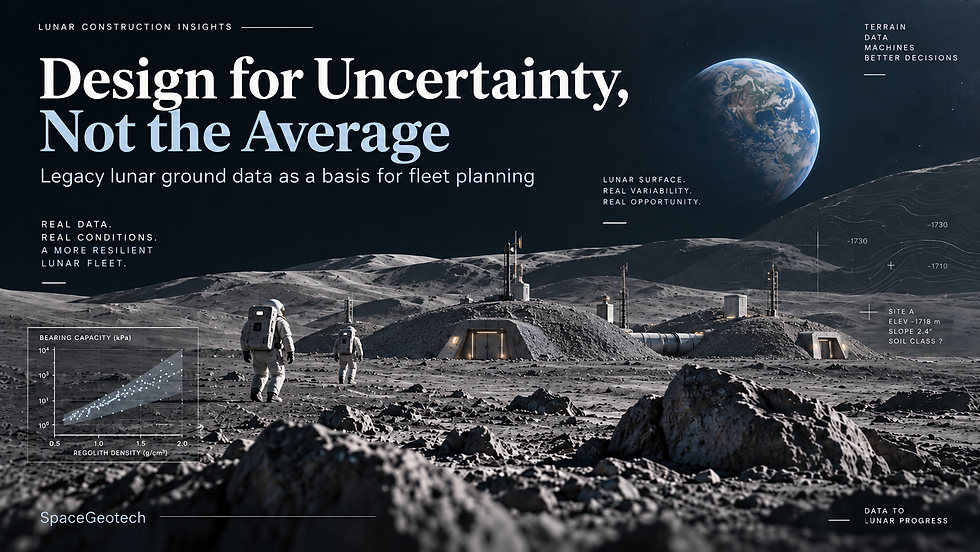
Without a state-based framework, regolith is often treated as a uniform material characterized by average properties. This approach is insufficient for construction, where localized variations control performance.
By introducing OCR* as a state parameter and LRC as a classification system, the CRF enables:
quantification of variability in mechanical behavior
prediction of construction response at relevant scales
alignment between design assumptions and actual ground conditions
reduction of reliance on empirical or density-based approximations
This aligns with the broader objective of readiness frameworks, which is to reduce uncertainty through progressive validation and evidence-based assessment (ESA, 2008).
5.6. Case Study: CRL Assessment for Lunar Landing Pad Construction
The construction of a lunar landing pad is one of the most demanding infrastructure problems due to the coupled effects of plume–surface interaction, regolith erosion, and repeated loading (Phillips et al., 1988; Eagle Engineering, 1988).
The construction of a lunar landing pad is one of the most demanding infrastructure problems due to the coupled effects of plume–surface interaction, regolith erosion, and repeated loading. The system is defined as a prepared surface capable of supporting landing and launch operations, limiting ejecta generation, and maintaining geometric and mechanical integrity over multiple cycles.
From a readiness standpoint, landing pad construction cannot be evaluated through material validation alone. It requires convergence between ground conditions, processing methods, energy systems, and execution capability. This reflects the broader limitation identified in infrastructure-focused TRL adaptations, where system integration and site dependency govern feasibility rather than component maturity alone.
The starting point for CRL assessment is the definition of ground conditions using OCR* and LRC.
At the landing site scale, the regolith profile is expected to exhibit a shallow disturbed layer (L1), underlain by progressively denser and more stable material (L2–L3). The mechanical response is controlled by low confinement and stress-history effects, influencing both excavation behavior and bearing response.
Key implications include:
High dust mobility and low strength at surface (L1), leading to poor trafficability and high erosion susceptibility
Increasing resistance with depth (L2–L3), affecting excavation energy and tool performance
Depth-dependent bearing response, requiring control of surface preparation to avoid excessive settlement
At CRL 2–3, these conditions are inferred from remote sensing, Apollo data, and simulant-based testing. However, uncertainty remains high, particularly in variability and scale effects.
Advancement beyond CRL 3 requires bounding this uncertainty through higher-fidelity testing and correlation with construction-scale behavior.
Within CRL assessment, the question is not whether these methods can produce strong materials, but whether they can be executed reliably under lunar conditions.
At CRL 3, laboratory testing may demonstrate that sintered regolith achieves sufficient compressive strength.
Advancement to CRL 4 requires demonstration of these processes under conditions that reproduce key boundary constraints, including vacuum, thermal cycling, and representative regolith properties. This aligns with TRL principles requiring validation in relevant environments but extends them to construction processes rather than isolated materials.
Advancement to CRL 5 requires demonstration that:
energy systems can sustain continuous or staged construction operations
excavation, transport, and processing systems can operate within mass and power limits
construction sequencing is compatible with operational constraints
This reflects the requirement, identified in readiness assessment processes, that viability must be evaluated alongside performance, including effort, cost, and integration into operational systems.
5.7. CRL Progression Summary
The progression of the landing pad system through CRL levels can be summarized as follows:
CRL 2–3: Concept and material feasibility demonstrated; ground conditions partially defined
CRL 4: Construction processes validated under relevant conditions; key uncertainties identified
CRL 5: Integrated system demonstrated, including logistics and execution constraints. Construction demonstrably executable with bounded uncertainty and predictable performance
This progression illustrates that readiness is governed by system convergence, not by isolated validation of materials or technologies.
Discussion: Implications for NASA Programs and Mission Planning
Current lunar programs are structured around system development, mission architecture, and technology maturation, with readiness primarily evaluated through Technology Readiness Levels. This approach has proven effective for spacecraft, instruments, and operational systems, where performance can be validated through progressive testing and demonstration. The underlying philosophy, established by NASA, is to reduce risk by advancing technologies from basic principles to operational environments through controlled validation.
However, infrastructure delivery introduces a different class of risk. It is not governed solely by whether systems function, but by whether they can be constructed, integrated, and sustained under site-specific conditions. As identified in prior adaptations of TRL for infrastructure, readiness assessments do not fully capture integration risks, environmental dependency, or the interaction between construction systems and ground conditions.
The introduction of the Construction Readiness Framework and CRL provides a mechanism to address this gap within existing program structures, without modifying or replacing TRL. It introduces an additional layer of evaluation focused on execution feasibility, enabling a more complete assessment of project readiness.
One of the primary implications of adopting CRL is the explicit separation between technology risk and construction risk.
Within current frameworks:
TRL addresses whether systems can perform their intended function
Program reviews evaluate integration at system level
However, neither explicitly addresses whether infrastructure can be constructed under operational constraints.
The CRL introduces this distinction:
Technology readiness evaluates system capability
Construction readiness evaluates deliverability
This separation allows program decisions to be based on a more accurate representation of risk. A system may be technologically mature while remaining non-constructible due to unresolved ground conditions, incompatible methods, or logistical constraints.
This distinction is consistent with broader readiness assessment principles, where different dimensions of risk must be evaluated independently before advancement (ESA, 2008).
The adoption of CRL introduces a structured and consistent approach to evaluating construction feasibility within lunar programs, extending existing review processes beyond system performance to include execution capability. It integrates construction-specific criteria into decision gates, ensuring that progression depends on validated ground conditions, demonstrated construction methods, and full system integration, including logistics and operational performance.
At the same time, CRL provides a unified framework for managing construction-related risks, addressing key uncertainties associated with ground behavior, method compatibility, logistical constraints, execution system performance, and long-term infrastructure stability. By requiring convergence across these domains, it ensures that risks are identified and reduced prior to deployment.
This approach also reshapes technology development. Technologies are no longer advanced solely based on functional performance, but on their compatibility with construction processes and ground conditions. This requires early integration of ground interaction testing, consideration of constructability in design, and validation within operational constraints, leading to a construction-driven development model.
At program level, CRL aligns engineering evaluation with the realities of infrastructure delivery, supports prioritization of site characterization and construction capabilities, and improves coordination across disciplines. It addresses a critical gap in current planning by providing a method to evaluate whether infrastructure can be built, not only whether systems can function.
Conclusions
This article introduces the Construction Readiness Framework (CRF) and the associated Construction Readiness Levels (CRL) as a structured methodology to evaluate the feasibility of lunar infrastructure delivery. The framework addresses a fundamental limitation in existing readiness approaches: the absence of a mechanism to assess whether infrastructure can be constructed under site-specific and operational constraints.
Technology Readiness Levels, as originally developed by NASA, provide a robust foundation for evaluating system maturity through progressive validation. Subsequent formalization and adoption across agencies, including the European Space Agency, have reinforced their role as a standard tool for managing technological risk. However, these frameworks remain focused on functionality and do not explicitly address construction as a coupled engineering process.
The CRF extends readiness assessment into the domain of infrastructure delivery by introducing a system-based approach grounded in five interacting domains: site conditions, construction methods, logistics, execution systems, and infrastructure integration. Within this framework, the CRL provides a quantitative measure of readiness based on convergence across these domains, ensuring that advancement reflects construction feasibility rather than isolated system performance.
A key contribution of the framework is the integration of ground intelligence through OCR* and LRC, enabling site conditions to be expressed as state-dependent mechanical parameters directly linked to construction behavior. This establishes ground conditions as a governing variable in readiness assessment, consistent with geotechnical engineering practice and essential for extraterrestrial construction.
The application scenario demonstrates that material validation and technology maturity are insufficient to establish readiness. Construction feasibility emerges only when ground conditions, methods, systems, and logistics are resolved as an integrated system. This finding reinforces the need for a construction-centric framework to complement existing technology-based approaches.
The adoption of CRF and CRL has direct implications for lunar programs. It enables clearer separation between technology and construction risk, supports more robust decision-making at program gates, and aligns engineering evaluation with the realities of infrastructure delivery. It also introduces a construction-driven perspective to technology development, ensuring that systems are designed and validated within the constraints of execution.
In this context, construction readiness is not a derivative of technology readiness. It is a distinct and necessary condition for infrastructure deployment. The CRF provides a defensible and implementable framework to evaluate this condition, supporting the transition from conceptual design to executable engineering in lunar environments.
References
de Moraes, R. (2024). Technology Readiness Level (TRL) and Application Readiness Level (ARL) Metric for Ground Engineering Applications. [Manuscript submitted for publication].
de Moraes, R., Maghoul, P., Anderson, R. C., & Malla, R. B. (2024). Surface Infrastructure Technology Readiness Level (SIRL). [Manuscript in preparation].
Eagle Engineering, Inc. (1988). Lunar surface construction & assembly equipment study (LBSS Task 5.3, EEI Report 88-194, NASA-CR-172105). NASA Johnson Space Center.
Eagle Engineering, Inc. (1988). Lunar base launch and landing facility conceptual design (2nd ed., LBSS Task 3.1, EEI Report 88-178, NASA-CR-172049). NASA Johnson Space Center.
European Space Agency (ESA). (2008). Technology readiness levels handbook for space applications (ESA TEC-SHS/555.1). ESA.
Heiken, G. H., Vaniman, D. T., & French, B. M. (Eds.). (1991). Lunar sourcebook: A user’s guide to the Moon. Cambridge University Press.
Mankins, J. C. (1995). Technology readiness levels: A white paper. NASA Office of Space Access and Technology, Advanced Concepts Office.
Mitchell, J. K., Houston, W. N., Carrier, W. D., III, & Costes, N. C. (1974). Apollo soil mechanics experiment S-200: Final report (NASA Contract NAS9-11266, Space Sciences Laboratory Series 15, Issue 7). University of California, Berkeley.
NASA. (2012). Technology readiness level (TRL) definitions and guidelines. NASA Systems Engineering Handbook (NASA/SP-2012-6105, Appendix G).
Phillips, P. G., Simonds, C. H., & Stump, W. R. (1988). Lunar base launch and landing facilities conceptual design. In W. W. Mendell (Ed.), Lunar bases and space activities of the 21st century (pp. 139–148). Lunar and Planetary Institute.
Sadin, S. R., Povinelli, F. P., & Rosen, R. (1989). The NASA technology push towards future space mission systems. Acta Astronautica, 20, 73–77. https://doi.org/10.1016/0094-5765(89)90054-4
Roberto de Moraes
Author | SpaceGeotech Founder


Comments