
We Still Do Not Know How the Lunar Surface Will Behave Under Construction
- May 28
- 20 min read
Lunar Regolith is Not a Layer Cake
Recent updates presented during NASA’s Moon Base and Ignition discussions made something increasingly clear: lunar activity is transitioning away from isolated exploration missions and toward the early stages of sustained surface operations.
The emphasis is no longer limited to landing systems and scientific access. Current discussions now include rover traffic networks, robotic excavation, regolith processing, landing pad preparation, berm construction, infrastructure deployment, and long-duration surface interaction. In engineering terms, this marks the beginning of the construction phase of lunar development.
For decades, lunar surface characterization has remained dominated by geological interpretation, orbital imagery, spectral mapping, and generalized descriptions of regolith thickness and composition. These approaches are scientifically valuable, but construction does not interact with geology conceptually. Construction interacts with mechanical behavior.
Apollo already demonstrated that the lunar surface is mechanically variable at operational scales. Similar-looking terrain produced substantially different penetration resistance, sinkage response, trafficability, wheel performance, excavation behavior, and astronaut mobility over relatively short distances. The Apollo soil mechanics investigations repeatedly showed that density, porosity, and strength varied locally and with depth, even within apparently similar terrain units.
This becomes critically important once infrastructure begins interacting repeatedly with the surface.
Landing operations disturb and redistribute fines. Rover traffic progressively modifies density and mobility response. Excavation alters local confinement conditions and ejecta distribution. Surface grading changes stress paths within the shallow regolith. Dust propagation affects mechanical systems beyond the immediate operational zone. Over time, the lunar surface ceases to behave as a passive terrain and instead becomes an evolving engineering environment.
Yet despite this transition, lunar surface discussions still frequently treat regolith as if it were a relatively uniform material layer whose behavior can be inferred primarily from composition or imagery.
The problem is not simply that the Moon remains incompletely characterized. The problem is that lunar construction still lacks a behavior-based engineering framework capable of translating surface observations, Apollo measurements, trafficability data, penetration resistance trends, and future in-situ investigations into operationally meaningful ground interpretations.
Engineering decisions require more than geological identification. They require interpretation of probable mechanical response under loading, disturbance, repeated traffic, excavation, vibration, and infrastructure interaction.
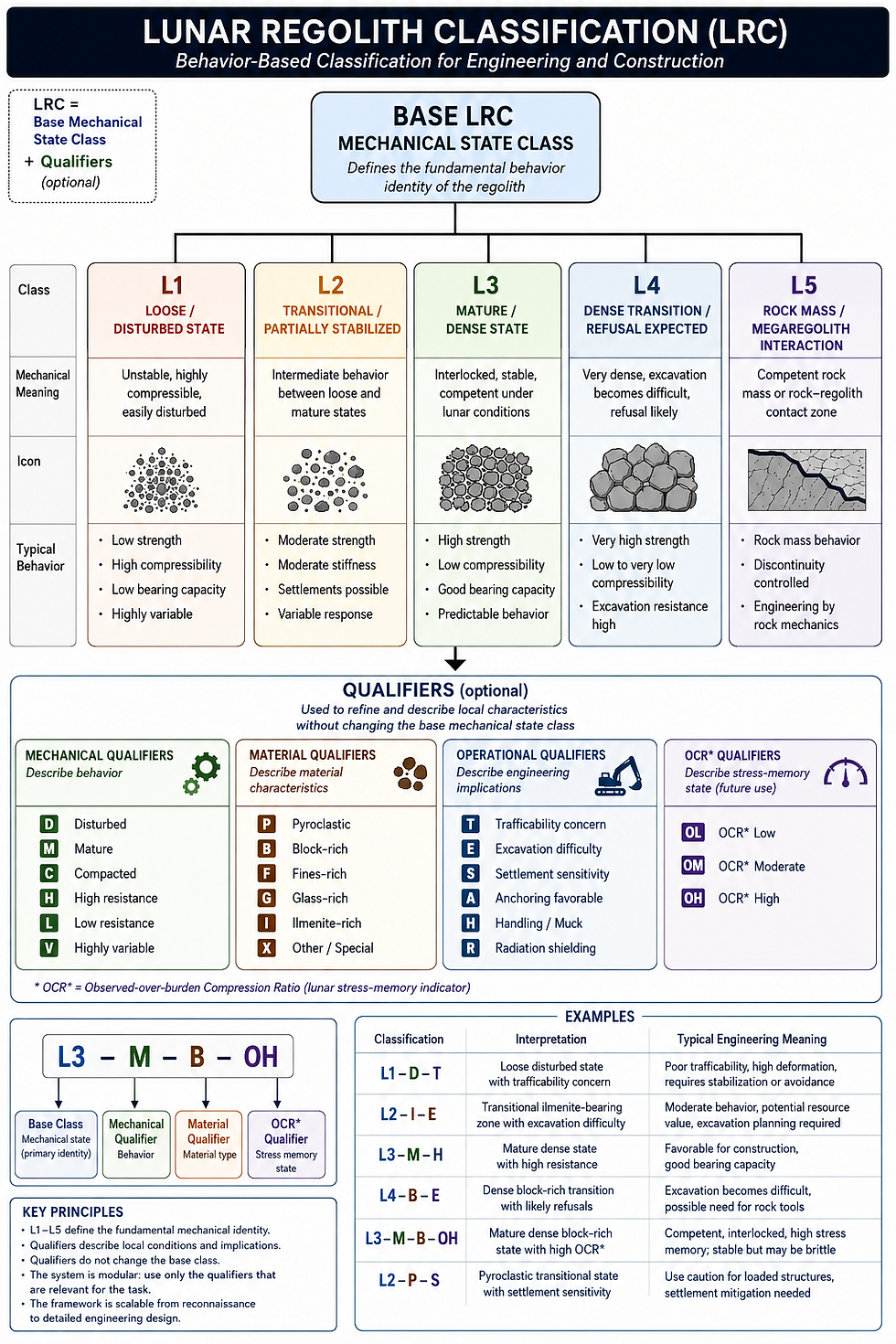
Within this context, the Lunar Regolith Classification (LRC) framework is proposed as a behavior-based engineering abstraction intended to support construction-oriented interpretation of lunar ground behavior. The framework does not seek to define geological stratigraphy or laterally continuous subsurface layers. Instead, LRC interprets the regolith as a mechanical-state system informed by Apollo soil mechanics observations, penetration resistance behavior, density evolution, excavation response, mobility performance, and subsequent lunar investigations (Figure 1).
LRC is not intended to answer only what the regolith is. It is intended to support the interpretation of how the regolith is likely to behave operationally.
Accordingly, L1–L5 should not be interpreted as deterministic subsurface layers, but as indicative mechanical-state domains representing probable transitions in disturbance sensitivity, compaction state, interlocking behavior, trafficability response, excavation resistance, and infrastructure suitability. Similar to operational ground classifications used in terrestrial geotechnics and tunneling, the framework functions as an engineering abstraction designed to organize incomplete ground knowledge into operationally useful construction domains under uncertainty.
This approach becomes increasingly necessary as lunar programs move toward repeated surface operations. Sustainable infrastructure will ultimately depend not only on identifying where resources exist, but on understanding how the lunar surface mechanically evolves once construction activity begins interacting with it continuously over time.
Why Geological Descriptions Alone Are Insufficient for Lunar Construction
Most current interpretations of the lunar surface remain dominated by geological descriptors such as grain size distribution, mineralogy, maturity, regolith thickness, crater density, and spectral classification. These datasets are scientifically essential and have significantly advanced the understanding of lunar evolution and regional surface processes. However, the requirements of construction engineering differ fundamentally from those of geological interpretation.
Construction does not interact with the surface through composition alone. Construction interacts with mechanical response.
This distinction becomes increasingly important as lunar programs transition from exploration toward sustained surface operations involving repeated traffic, excavation, grading, landing pad preparation, berm construction, anchoring systems, infrastructure emplacement, and long-duration operational loading.
Apollo observations repeatedly demonstrated that visually similar terrain could produce substantially different operational behavior. Penetration resistance, wheel sinkage, rover mobility, excavation difficulty, footprint depth, and regolith disturbance varied over relatively short distances despite broadly similar geological appearance. Apollo soil mechanics investigations concluded that density, porosity, and strength varied both locally and with depth, including meter-scale variations within the same operational area.
The shallow lunar surface behaves as a mechanically active material system influenced by disturbance history, fabric evolution, particle interlocking, local compaction state, ejecta redistribution, impact processing, and repeated environmental cycling. Consequently, similar mineralogical descriptions do not necessarily imply similar engineering performance.
This limitation becomes evident when attempting to translate orbital or geological information directly into construction decisions. Surface imagery may identify terrain morphology but cannot independently determine bearing response, excavation resistance, settlement sensitivity, trafficability degradation, or potential for mechanical disturbance. Likewise, regolith thickness estimates alone provide limited insight into how the shallow surface will respond under repeated operational loading (Figure 2).
Even density, often treated as a governing parameter in lunar engineering discussions, does not fully resolve the problem. Apollo-era observations showed that high penetration resistance could occur at shallow depths despite negligible gravitational confinement. This behavior indicates that the lunar regolith response is strongly influenced by mechanical state and stress history rather than by density alone.

Engineering operations require a framework capable of translating incomplete surface observations and localized measurements into operationally meaningful expectations of ground behavior under construction conditions. This need is not unique to lunar engineering. Terrestrial geotechnical and rock mechanics practice routinely employs operational abstractions such as rock mass classifications, tunneling ground classes, excavation domains, and observational-method zoning systems precisely because natural ground conditions are inherently variable and incompletely known.
The Lunar Regolith Classification (LRC) framework is proposed within this context.
Rather than treating the lunar surface as a uniform material layer or deterministic stratigraphy, LRC interprets the shallow regolith as a set of indicative mechanical-state domains associated with probable operational behavior. The framework is therefore behavior-oriented rather than composition-oriented. Its purpose is not to eliminate uncertainty, but to organize it into operationally meaningful engineering interpretations that support construction planning, mobility assessment, excavation expectations, and future in-situ verification strategies.
Accordingly, LRC should not be interpreted as a geological layering model. The framework instead represents a construction-oriented abstraction of probable mechanical transitions within the shallow lunar environment under evolving operational interaction.
The Mechanical Problem Hidden in the First Meters of the Moon
The shallow lunar surface represents one of the least mechanically constrained environments ever considered for large-scale construction activity.
Unlike terrestrial soils, lunar regolith exists under extremely low gravitational confinement. Even at depths approaching several meters, the effective overburden stresses remain very small compared with typical terrestrial geotechnical conditions. Yet Apollo observations repeatedly demonstrated that the shallow regolith can still exhibit relatively high penetration resistance, significant wheel support capability, localized dense response, and abrupt excavation resistance changes (Figure 3).

Under terrestrial conditions, increasing soil resistance is commonly associated with increasing confinement and burial stress. On the Moon, however, high resistance may occur within the upper tens of centimeters despite negligible overburden pressure. The shallow lunar surface, therefore, behaves differently from a purely gravity-controlled granular system.
Apollo soil mechanics investigations documented strong local variability in density, porosity, strength, and trafficability behavior. Relative density below depths of approximately 10 to 20 cm was often interpreted as high despite the extremely low in-situ stress environment. Penetration resistance measurements and trenching observations further indicated abrupt transitions between loose surficial material and more resistant subsurface zones. Astronaut descriptions repeatedly referenced localized hard layers, compacted behavior, and excavation resistance inconsistent with a uniformly loose granular deposit.
The consequence is that the first meters of the Moon cannot be interpreted simply as unconsolidated dust.
Instead, the shallow regolith behaves as a mechanically evolving particulate system influenced by repeated impact processing, particle rearrangement, fabric interlocking, ejecta redistribution, thermal cycling, electrostatic effects, and progressive disturbance history accumulated over geological time. The resulting mechanical response depends not only on material composition, but on the evolving state of the regolith structure itself (Figure 4).
Landing pads, rover traffic corridors, excavation systems, berm construction, anchoring operations, and surface infrastructure all interact primarily with the shallow subsurface zone. These activities repeatedly disturb, compact, shear, excavate, vibrate, and redistribute the upper regolith layers. Consequently, construction performance becomes governed not only by static material properties but by how the regolith mechanically evolves under repeated operational interaction.
The near-surface environment, therefore, presents two simultaneous engineering conditions.

The uppermost regolith remains highly disturbance-sensitive and potentially dust-generative under relatively small mechanical interaction. At the same time, localized resistance and dense response may emerge abruptly at shallow depths despite the absence of significant confinement. This produces a mechanically transitional environment in which trafficability, excavation behavior, settlement response, and bearing performance may change substantially over relatively short vertical and lateral distances.
Recent in-situ investigations continue to reinforce this interpretation. Chang’E-6 subsurface radar observations identified distinct shallow transitions between fine-grained surficial material and coarser underlying ejecta deposits within the upper few meters of the regolith. While such observations remain geophysical rather than mechanical, they further support the view that the shallow lunar surface cannot be interpreted as mechanically uniform.
The engineering challenge, therefore, extends beyond identifying regolith thickness or composition. The challenge is understanding how shallow lunar ground transitions between disturbance-sensitive, partially stabilized, interlocked, and refusal-prone mechanical states under evolving operational interaction.

It is within this context that behavior-based interpretation frameworks such as the Lunar Regolith Classification (LRC) become necessary for future construction-oriented lunar engineering.
From Stratigraphy to Mechanical-State Interpretation
The Lunar Regolith Classification (LRC) framework is not proposed as a stratigraphic model of the lunar subsurface. It is an operational geotechnical abstraction intended to organize observed mechanical behavior into interpretable state domains relevant to mobility, excavation, and infrastructure interaction.
Stratigraphy attempts to reconstruct depositional history through laterally continuous geological units defined by origin, composition, age, or depositional sequence. In contrast, the LRC framework is based on mechanical response. The framework does not assume that the lunar subsurface consists of uniform, continuous, or deterministic layers with globally repeatable boundaries. Apollo observations, penetration measurements, trenching operations, rover trafficability behavior, and core tube samples consistently demonstrate strong small-scale variability in density, resistance, disturbance state, and particle arrangement over distances ranging from centimeters to meters.
The near-surface lunar environment is mechanically heterogeneous by nature. Impact gardening, ejecta emplacement, local compaction, repeated disturbance, vesicular fragment concentration, slope processes, and secondary cratering continuously modify the regolith fabric. As a result, mechanically distinct zones may exist without corresponding mineralogical or stratigraphic discontinuities. Conversely, similar particle size distributions may produce significantly different engineering responses depending on packing state, stress memory, and disturbance condition.
Accordingly, the LRC framework should not be interpreted as a deterministic layered profile analogous to terrestrial sedimentary stratigraphy. The proposed L1–L5 domains are indicative mechanical regimes representing statistically dominant behavioral tendencies rather than fixed geological units. Their boundaries are diffuse, transitional, and site-dependent.
This interpretation philosophy is fully consistent with established geotechnical engineering practice. Terrestrial geotechnics routinely employs operational classifications that do not correspond directly to geological stratigraphy. Rock Mass Rating (RMR), the Q-system, excavation support classes, TBM ground domains, and observational-method zoning frameworks all simplify highly variable ground conditions into manageable engineering abstractions. These systems do not claim lithological uniformity or deterministic continuity. Instead, they organize uncertainty into operationally useful categories that allow engineering decisions to proceed despite incomplete information.
For example:
RMR and Q-system classifications translate discontinuity conditions, joint spacing, weathering, and groundwater effects into support recommendations without implying homogeneous rock masses.
Tunnel excavation classes routinely group highly variable geology into representative support domains based on expected deformation and stability behavior.
TBM domain classifications simplify transitions between soil, mixed-face, weathered rock, and competent rock into operational excavation regimes, even when boundaries are irregular and transitional.
Geotechnical zoning frameworks used in dams, mining, underground construction, and transportation corridors frequently employ observational domains that evolve as new information becomes available during construction.
The LRC framework follows the same engineering logic.
Its purpose is not geological reconstruction. Its purpose is to translate highly scattered lunar observations into a mechanics-based structure suitable for preliminary engineering interpretation under uncertainty.
Within this framework, the L1–L5 domains should therefore be interpreted as:
indicative mechanical-state domains,
not deterministic stratigraphic units,
not globally continuous layers,
not fixed-depth horizons,
and not universally transferable profiles between lunar sites.
Depth ranges associated with the domains are approximate operational references only. Local transitions may occur earlier, later, or may be absent entirely, depending on terrain maturity, ejecta history, slope processes, local disturbance, or impact-related heterogeneity.
The boundaries between domains are intentionally diffuse. For example, the transition from L1 to L2 should not be interpreted as a discrete interface. Rather, it represents a gradual shift from highly disturbed, compressible, and mechanically variable near-surface material toward increasingly interlocked and mechanically stable regolith. Similarly, transitions into deeper domains represent progressive increases in resistance persistence, confinement effects, and fabric stability rather than abrupt lithological changes.
To avoid deterministic interpretation, the framework adopts the use of qualifiers where appropriate. Terms such as “dominantly,” “indicative,” “transitional,” “locally variable,” and “mechanically representative” are intentionally used throughout the classification. These qualifiers are not linguistic caution; they are integral to the framework’s scientific validity because the available lunar dataset remains sparse, spatially discontinuous, and operationally constrained.
This treatment of uncertainty is deliberate. The framework recognizes that future in-situ investigations may reveal substantial departures from current interpretations at local scales. Such outcomes would not invalidate the framework itself, because the framework is not based on deterministic layering assumptions. Rather, its role is to provide a structured method for organizing mechanical variability into interpretable engineering domains while preserving uncertainty explicitly.
This distinction is especially important for future CPT-like measurements and shallow geotechnical investigations. Penetration resistance variability should not automatically be interpreted as evidence of distinct stratigraphic horizons. In many cases, variations may instead reflect differences in fabric state, stress memory, disturbance condition, or local packing efficiency within mechanically similar materials.
The operational value of the framework therefore, lies in its ability to stabilize interpretation despite incomplete information.
Without such abstraction, lunar geotechnical interpretation becomes dominated by isolated measurements lacking transferable engineering context. Conversely, excessive simplification into deterministic layers creates a false impression of predictability unsupported by Apollo-era observations.
The LRC framework seeks an intermediate position between these extremes:
a structured but uncertainty-aware mechanical interpretation system.
Within this context, OCR* operates as the complementary state descriptor governing the mechanical response within and across these domains. The LRC framework organizes the regolith into operational behavioral zones, while OCR* provides the mechanics-based interpretation of stress memory and state persistence that explains why similar materials may exhibit fundamentally different resistance and deformation behavior under low lunar confinement.
Together, the two frameworks establish a non-deterministic but operationally coherent basis for interpreting lunar surface mechanics in support of mobility assessment, excavation planning, and future infrastructure development.
The Lunar Regolith Classification (LRC) Framework
The Lunar Regolith Classification (LRC) framework organizes the shallow lunar subsurface into indicative mechanical-state domains intended to support engineering interpretation under operational conditions. The framework is construction-oriented and behavior-based. It is designed to assist the interpretation of probable regolith response during mobility operations, excavation, grading, trafficability assessment, shallow infrastructure interaction, and future in-situ geotechnical investigations.
The framework does not attempt to establish deterministic geological stratigraphy, constitutive behavior laws, or design-grade engineering parameters. Instead, LRC functions as an operational interpretation system that organizes incomplete and spatially variable lunar observations into mechanically meaningful domains relevant to construction performance.
Within this structure, the L1–L5 domains represent progressively evolving mechanical states associated with changes in disturbance sensitivity, compaction condition, particle interlocking, penetration resistance persistence, excavation behavior, and operational response under low lunar confinement.
The domains are intentionally indicative rather than absolute. Depth ranges are approximate references inferred from Apollo observations, penetration resistance trends, excavation response, trenching behavior, and regolith mechanics investigations. Actual transitions are expected to vary significantly with terrain maturity, ejecta processes, local disturbance history, slope environment, and impact-related heterogeneity.
L1 - Disturbed Surface State
L1 represents the highly disturbed near-surface regolith zone directly exposed to continuous surface interaction and environmental cycling. This domain is characterized by loose particulate structure, elevated disturbance sensitivity, low confinement, and high susceptibility to dust mobilization and local deformation.
Operationally, L1 corresponds to the zone most strongly affected by landing plume interaction, wheel disturbance, repeated traffic, shallow grading, and astronaut mobility. Mechanical response within this domain is highly variable and may change rapidly under repeated loading or disturbance.
Typical characteristics include:
elevated compressibility,
shallow sinkage susceptibility,
low penetration persistence,
localized sloughing,
dust generation,
and unstable excavation margins.
Although low-strength behavior commonly dominates within this domain, local compacted patches or ejecta fragments may still generate abrupt resistance variations over small scales.
From an operational perspective, L1 represents the primary trafficability and surface-disturbance control zone for early lunar construction activities.
L2 - Transitional/Partially Stabilized State
L2 represents a mechanically transitional domain between the highly disturbed surficial regolith and progressively interlocked subsurface states. This zone is characterized by increasing particle interaction, partial fabric stabilization, moderate resistance persistence, and reduced disturbance sensitivity relative to L1.
The transition into L2 does not occur through a discrete interface. Instead, the domain reflects gradual mechanical evolution associated with increasing packing efficiency, local compaction effects, and progressive reduction in near-surface disturbance influence.
Operationally, L2 may provide improved support for rover mobility, shallow traffic lanes, temporary staging zones, and lightly loaded infrastructure systems compared with L1. However, mechanical response variability remains significant and localized settlement or excavation behavior may still be difficult to predict.
Indicative characteristics include:
moderate penetration resistance increase,
partial excavation wall stability,
reduced sinkage relative to L1,
moderate trafficability improvement,
and increasingly persistent load response.
This domain is expected to govern many shallow operational interactions during early infrastructure deployment.
L3 - Mature/Dense Mechanical State
L3 represents a mechanically mature and increasingly interlocked regolith state characterized by relatively stable load response, higher penetration resistance persistence, and reduced disturbance sensitivity under operational loading.
Within this domain, the regolith fabric behaves more coherently under excavation, wheel interaction, and shallow foundation loading. Apollo trenching observations and penetration resistance trends suggest that localized dense conditions may emerge within relatively shallow depths despite extremely low gravitational confinement.
Mechanical response within L3 is interpreted as increasingly governed by interparticle interlock, fabric evolution, and stress-memory persistence rather than by present overburden stress alone.
Indicative operational behavior includes:
improved bearing response,
reduced compressibility,
more predictable mobility performance,
stable excavation geometry over short durations,
and increasing excavation energy demand.
L3 is considered one of the most operationally favorable domains for shallow infrastructure interaction and mobility corridor development under current conceptual lunar construction scenarios.
L4 - Dense Transitional/Refusal-Prone State
L4 represents a dense transitional mechanical regime where excavation resistance, penetration persistence, and localized refusal behavior become increasingly dominant. This domain may include compacted regolith, coarse ejecta concentration, block-rich material, or transitional interaction between regolith and fractured rock mass conditions.
Operationally, L4 introduces substantial uncertainty for excavation systems, drilling operations, anchoring approaches, and robotic construction equipment. Abrupt increases in resistance may occur over short distances, producing excavation interruptions, torque spikes, tool wear acceleration, and reduced mobility predictability.
Indicative characteristics include:
high penetration resistance,
low deformability,
localized refusal behavior,
increased excavation energy demand,
coarse fragment interaction,
and stronger stress-memory persistence.
This domain may become increasingly important for future subsurface construction, resource extraction, and excavation system design.
L5 - Rock Mass/Megaregolith Interaction State
L5 represents the transition from regolith-dominated response toward fractured rock mass and megaregolith interaction conditions. Mechanical behavior within this domain becomes increasingly governed by discontinuities, block interaction, fracture persistence, local lithology, and rock mechanics processes rather than particulate regolith response alone.
Operationally, this domain corresponds to conditions where excavation methods, drilling systems, stabilization approaches, and support strategies transition from soil-mechanics-dominated behavior toward rock engineering considerations.
Indicative characteristics include:
excavation refusal under regolith-based systems,
block-controlled deformation,
fractured rock interaction,
localized competent rock behavior,
and discontinuity-governed mechanical response.
The transition into L5 is expected to vary substantially between mare, highland, ejecta, and volcanic terrains and cannot presently be generalized globally.
Qualifiers and Operational Interpretation
To preserve flexibility and uncertainty awareness, the LRC framework incorporates optional qualifiers intended to refine interpretation without altering the base mechanical-state classification.
Qualifiers may describe:
disturbance condition,
block concentration,
fines content,
excavation behavior,
trafficability sensitivity,
resistance persistence,
stress-memory tendency,
or operational constraints observed during in-situ interaction.
The qualifier system allows the framework to evolve progressively as future lunar datasets expand while preserving the underlying mechanical-state structure.
For example:
an L2 domain may exhibit localized trafficability concerns,
an L3 domain may contain block-rich excavation hazards,
or an L4 domain may transition abruptly into fractured megaregolith interaction.
The framework, therefore, supports operational interpretation without imposing deterministic layering assumptions.
Most importantly, the LRC framework is intended to organize engineering uncertainty rather than eliminate it.
Its primary value lies in providing a structured mechanics-based language capable of linking Apollo observations, future robotic investigations, penetration measurements, excavation response, and mobility performance into a coherent operational interpretation system for lunar construction engineering.
Operational Interpretation of LRC for Lunar Construction
The operational significance of the Lunar Regolith Classification (LRC) framework emerges through its ability to translate highly variable lunar surface conditions into interpretable engineering expectations relevant to construction activity.
The framework is not intended to predict exact performance outcomes. Rather, it provides a structured interpretation of probable mechanical behavior under operational interaction. This distinction is important because future lunar construction will occur under conditions where direct site investigation data remain sparse, localized, and operationally constrained.
Within this context, the value of LRC lies in supporting engineering judgment under uncertainty.
Trafficability and Mobility Performance
One of the most immediate applications of the framework relates to trafficability and rover mobility.
Apollo operations demonstrated that wheel sinkage, traction response, and mobility performance varied substantially over relatively short distances despite visually similar terrain conditions. Localized soft zones, shallow compaction transitions, ejecta fragments, and abrupt resistance changes all influenced rover behavior and astronaut traverses.
Within the LRC framework, trafficability response is interpreted primarily through the mechanical state of the shallow subsurface rather than through terrain appearance alone.
L1-dominated zones are expected to exhibit:
elevated disturbance sensitivity,
increased sinkage potential,
dust mobilization,
reduced traction consistency,
and progressive degradation under repeated traffic.
In contrast, L2 and L3 domains are interpreted as progressively more stable mobility environments where wheel support becomes increasingly governed by interlocked particulate behavior and persistent load response.
The framework also supports interpretation of traffic-induced regolith evolution over time. Repeated rover interaction may progressively compact, densify, redistribute, or locally destabilize shallow regolith depending on the initial mechanical state. Consequently, trafficability should not be treated as static.
Excavation and Grading Operations
Apollo trenching operations demonstrated that excavation resistance may change abruptly over shallow depths, including transitions from loose surficial material into compacted or highly resistant zones within the upper tens of centimeters. Astronaut observations repeatedly described localized hard digging conditions and resistant trench floors despite extremely low lunar gravity.
These interpretations are directly relevant to:
berm construction,
landing pad preparation,
cable trenching,
regolith moving operations,
robotic excavation systems,
and ISRU feedstock handling.
Importantly, the framework recognizes that excavation performance is not governed solely by density. Excavation resistance may instead depend strongly on local fabric interlock, stress-memory persistence, block concentration, and disturbance condition.
This interpretation is particularly relevant under low-gravity conditions where excavation forces, spoil behavior, particle lofting, and machine-ground interaction differ substantially from terrestrial expectations.
Landing Pads and Surface Stabilization
Future landing systems will repeatedly interact with the shallow regolith through plume loading, ejecta redistribution, thermal effects, and localized surface erosion.
Within the LRC framework, L1-dominated surfaces are interpreted as highly sensitive to plume-induced disturbance and particulate mobilization. Repeated landings in such environments may progressively alter surface morphology, degrade nearby infrastructure zones, and increase dust propagation risk.
The framework, therefore, supports interpretation of:
surface stabilization needs,
grading requirements,
berm effectiveness,
and progressive operational degradation around landing zones.
L2 and L3 domains may provide more favorable conditions for long-term landing infrastructure because of their increasingly stable particulate response and reduced disturbance sensitivity. However, even these domains remain mechanically variable and require direct in-situ verification.
Shallow Foundations and Infrastructure Interaction
The framework also provides operational interpretation relevant to shallow infrastructure systems, including:
habitats,
solar arrays,
mobility platforms,
surface anchors,
utility corridors,
and robotic staging systems.
Under L1 conditions, infrastructure interaction is expected to remain highly sensitive to localized settlement, repeated disturbance, and shallow compressibility effects. L2 conditions may permit improved support response but still require uncertainty-aware design assumptions.
L3 domains are interpreted as the most favorable shallow construction environments within the current framework because of:
improved load persistence,
lower compressibility,
more stable mobility interaction,
and reduced disturbance sensitivity.
However, the framework does not imply that L3 conditions eliminate engineering risk. Rather, these domains represent comparatively more stable operational states within an inherently variable environment.
Localized transitions into L4 conditions may also generate excavation refusal, anchoring difficulties, or abrupt resistance increases during shallow construction activity. Such transitions may occur over relatively short distances and therefore require adaptive operational planning.
Dust Sensitivity and Surface Evolution
Dust behavior cannot be separated from the mechanical state. Within the framework, dust sensitivity is interpreted primarily as a function of disturbance condition, fines mobility, shallow confinement, and operational interaction intensity. L1 environments are expected to exhibit the greatest dust mobilization potential due to loose particulate structure and elevated disturbance sensitivity.
Repeated traffic, excavation, landing operations, and grading may progressively modify this response over time by either compacting the surface locally or generating additional loose particulate material through repeated fragmentation and disturbance.
The framework treats lunar construction as an evolving surface-mechanics problem rather than as interaction with a static terrain condition.
Operational Value of the Framework
The operational value of LRC does not lie in deterministic prediction. Its value lies in establishing a transferable engineering interpretation structure capable of organizing incomplete lunar observations into coherent operational expectations.
Without such a framework, individual measurements remain isolated observations with limited engineering context. Conversely, a deterministic interpretation of the lunar surface as a uniform layered system creates unrealistic expectations of predictability unsupported by Apollo-era evidence.
The LRC framework instead provides:
an uncertainty-aware operational interpretation system,
a transferable mechanics-based classification language,
and a structured bridge between lunar observations and future construction engineering decision-making.
In this role, the framework functions less as a geological classification and more as a construction-oriented operational model for interpreting how the lunar surface is likely to behave as sustained infrastructure interaction begins to increase over time.
Limitations and Future Evolution of the Framework
The Lunar Regolith Classification (LRC) framework is intentionally proposed as an operational engineering interpretation system rather than as a deterministic geological or constitutive model. Its purpose is to organize highly variable and incomplete lunar observations into mechanically meaningful domains capable of supporting preliminary construction-oriented interpretation under uncertainty.
Accordingly, several important limitations must be stated explicitly.
First, the framework is not a geological model. LRC does not attempt to reconstruct lunar depositional history, define lithostratigraphic units, or establish globally continuous subsurface layering. The L1–L5 domains represent indicative mechanical-state interpretations inferred from operational observations, penetration behavior, excavation response, and regolith mechanics investigations rather than formal geological stratigraphy.
Second, the framework should not be interpreted as a deterministic subsurface profile. Domain transitions are intentionally diffuse, nonuniform, and site-dependent. Local variations associated with ejecta emplacement, impact gardening, slope processes, buried fragments, compaction state, and disturbance history may produce abrupt mechanical changes over relatively short distances. Consequently, the framework cannot presently support deterministic prediction of layer depth, thickness, continuity, or lateral persistence.
Third, the framework is not intended for design-grade parameter derivation. LRC does not provide constitutive relationships, settlement predictions, shear strength parameters, excavation energy equations, or foundation design criteria. The framework instead supports operational interpretation of probable mechanical behavior under uncertainty. Quantitative design applications require future in-situ testing, site-specific measurements, and independent calibration datasets.
Fourth, the framework is not a substitute for direct geotechnical investigation. Future lunar infrastructure systems will ultimately require mechanical verification through penetration testing, excavation trials, mobility experiments, plate loading, trafficability measurements, drilling response, and long-term operational monitoring. Orbital observations and classification frameworks alone cannot resolve construction-scale uncertainty.
The available lunar geotechnical dataset remains sparse relative to the complexity of the problem being addressed. Apollo observations were geographically limited, operationally constrained, and not acquired within a dedicated construction-engineering framework. Consequently, the purpose of LRC is not to eliminate uncertainty, but to stabilize interpretation while uncertainty remains unavoidable.
Within this context, the framework is expected to evolve progressively as future datasets become available.
One of the most immediate areas of future refinement involves expansion of the qualifier system. Current qualifiers are intentionally conceptual and operational. However, future robotic investigations and in-situ measurements may support development of increasingly structured descriptors associated with disturbance sensitivity, fines mobility, excavation resistance persistence, block concentration, trafficability degradation, and localized stress-memory behavior.
Future integration with OCR* also represents an important area of development. Within the present framework, LRC organizes the regolith into indicative operational mechanical domains, while OCR* provides a complementary interpretation of stress memory and state persistence under low lunar confinement. As future penetration measurements, excavation response datasets, and repeated-loading experiments become available, stronger coupling between mechanical-state domains and OCR*-based stress-history interpretation may become possible.
The framework may also evolve toward probabilistic interpretation domains rather than purely descriptive classifications. Instead of representing domains as fixed operational states, future implementations may incorporate likelihood-based transition mapping associated with:
penetration resistance distributions,
mobility performance envelopes,
excavation variability,
or disturbance propagation behavior.
Such approaches would align more closely with uncertainty-aware geotechnical zoning methods used in terrestrial infrastructure projects.
Robotic characterization systems and future CLPS missions may provide especially important opportunities for framework validation and refinement. Penetration devices, mobility rovers, excavation experiments, shallow drilling systems, trafficability rigs, and construction-oriented payloads could progressively establish direct relationships between observed operational performance and interpreted mechanical-state domains.
Importantly, future validation should prioritize mechanical interaction rather than remote sensing alone.
Orbital imagery, radar sounding, gravimetry, and spectral observations may help constrain regional geological context and broad subsurface variability, but engineering decisions ultimately require direct mechanical verification. Construction performance depends on load response, disturbance evolution, excavation resistance, settlement behavior, mobility interaction, and infrastructure-ground coupling that cannot presently be resolved through remote characterization methods alone.
The framework may also evolve into a monitoring-oriented operational system. As sustained lunar activity increases, repeated rover traffic, excavation operations, landing events, and infrastructure deployment are expected to progressively modify the shallow mechanical state of the regolith itself. Under such conditions, future LRC interpretation may incorporate temporal evolution associated with construction disturbance, traffic-induced compaction, excavation-induced destabilization, dust redistribution, and operational surface degradation.
This possibility is particularly important because it implies that future lunar construction sites may not remain mechanically static over time.
Ultimately, the LRC framework should be interpreted as an initial construction-oriented engineering abstraction for organizing lunar mechanical uncertainty rather than as a finalized classification system. Its value lies not in claiming a deterministic understanding of the lunar subsurface, but in establishing a structured mechanics-based language capable of evolving alongside future lunar geotechnical investigation and operational experience.
Roberto Moraes
Author | SpaceGeotech Founder
Lunar Infrastructure Governance and Construction Specialist


Comments