
Construction Baselines for Lunar Infrastructure
Introduction
Infrastructure is not delivered through technology alone. It is delivered through engineering frameworks that organize technical information into a consistent basis for planning, design, construction, verification, operations, and long-term asset management. Regardless of project scale or sector, infrastructure development depends on a common engineering understanding of the physical environment, design constraints, construction conditions, performance requirements, and the uncertainties that influence project execution.
Major civil infrastructure projects establish this foundation through engineering baselines developed before detailed design and construction planning commence. These baselines integrate site characterization, environmental conditions, engineering assumptions, project constraints, and performance objectives into a common technical reference that guides project development from initial planning through commissioning and operations. As additional information becomes available, the baseline evolves in a controlled manner while preserving the engineering rationale supporting previous decisions and maintaining consistency across multiple technical disciplines.
Lunar infrastructure presents the same engineering requirements, yet under significantly greater uncertainty. Current development efforts have produced substantial advances in remote sensing, scientific investigations, surface operations, robotics, power systems, and in situ resource utilization. These activities have generated an expanding body of scientific and engineering information, but they have largely evolved to satisfy individual disciplinary objectives. Although each contributes valuable knowledge, their integration into a unified engineering framework capable of supporting infrastructure delivery has received comparatively limited attention.
As lunar activities progress beyond exploration toward permanent installations, transportation networks, utility systems, resource processing facilities, and underground infrastructure, engineering decisions will increasingly depend on the ability to integrate information from multiple disciplines into a coherent technical foundation. Geological observations, geotechnical investigations, environmental characterization, operational constraints, logistics planning, and engineering assumptions cannot remain independent sources of information. They must become components of a single engineering framework that supports consistent project development throughout the infrastructure lifecycle.
This article introduces the Construction Baseline as that engineering framework. It defines the purpose of a Construction Baseline, identifies its principal components, and examines its role in supporting infrastructure planning, design, construction, verification, and long-term operations. Rather than proposing an additional project management process, the article argues that Construction Baselines constitute a fundamental engineering deliverable and provide the technical foundation upon which future lunar infrastructure programs, engineering standards, and construction governance frameworks can be systematically developed.
Construction Baselines as an Engineering Foundation
Engineering projects are developed through successive stages of increasing technical maturity. During this progression, decisions are made long before complete knowledge of the construction environment is available. The role of a Construction Baseline is to provide a consistent engineering foundation that supports these decisions by integrating the information, assumptions, constraints, and performance expectations that govern infrastructure development.
A Construction Baseline is neither a single document nor a repository of engineering data. It is an integrated engineering framework that consolidates the technical information required to develop infrastructure from conceptual planning through detailed design, construction, commissioning, and operations. By establishing a common technical basis across engineering disciplines, the baseline reduces inconsistencies, improves coordination, and preserves the rationale supporting engineering decisions as projects evolve.
In contrast with scientific investigations, whose objective is to expand knowledge, or technology development programs, which demonstrate system capability, infrastructure projects are fundamentally concerned with the reliable delivery of permanent assets. This distinction requires an engineering framework that translates scientific observations and technological capabilities into information directly applicable to infrastructure planning, constructability, structural performance, operational reliability, and long-term asset management.
The value of a Construction Baseline lies not in the volume of information it contains, but in its ability to organize engineering knowledge into a coherent and traceable framework. Geological observations, environmental characterization, logistics analyses, engineering assumptions, design constraints, and performance requirements acquire engineering value only when they are integrated into a common reference that supports consistent project development across multiple technical disciplines.
A Construction Baseline is also inherently dynamic. As site investigations progress, technologies mature, prototype testing is completed, and operational experience expands, new engineering evidence becomes available. The baseline evolves accordingly, incorporating validated information while preserving the technical basis upon which earlier project decisions were made. This continuous refinement progressively reduces uncertainty, strengthens engineering confidence, and improves the quality of subsequent planning, design, construction, and operational activities.
For lunar infrastructure, the Construction Baseline represents the transition from collecting engineering information to establishing an engineering framework capable of supporting infrastructure delivery. It provides the technical continuity required to integrate multiple engineering disciplines into a common foundation from which infrastructure systems can be planned, designed, constructed, verified, and operated with increasing confidence.
Information Required Before Design Begins
Engineering design is fundamentally limited by the quality, relevance, and maturity of the information upon which it is based. No infrastructure project begins with complete knowledge of the construction environment; however, every project requires sufficient engineering evidence to justify the decisions appropriate to its stage of development. The progression from conceptual design to detailed engineering is therefore governed not by the quantity of available data, but by the confidence that the available information provides for a particular engineering purpose.
For lunar infrastructure, this distinction is particularly important. Scientific observations, orbital datasets, laboratory testing, numerical modelling, terrestrial analogue investigations, and operational experience each contribute valuable knowledge of the lunar environment. Individually, however, these sources do not establish an adequate basis for infrastructure design. Their engineering value depends on their ability to characterize the conditions that govern construction, predict infrastructure performance, and quantify the uncertainties that remain relevant to project development.
The information required before design begins varies according to the type of infrastructure, project complexity, construction methodology, operational objectives, and the consequences of failure. Preliminary concepts may reasonably rely on interpreted engineering conditions and conservative assumptions, whereas detailed design requires progressively higher levels of confidence supported by direct measurements, validated analytical models, prototype testing, and, where practicable, site-specific investigations. Advancing design without a corresponding increase in engineering confidence transfers uncertainty from planning into construction, where its consequences are more difficult and costly to manage.
Consequently, the objective of a Construction Baseline is not to eliminate uncertainty before design activities commence. Engineering has always progressed under conditions of incomplete information. The objective is to identify the uncertainties that influence infrastructure performance, distinguish established engineering evidence from working assumptions, and define the technical information required before subsequent project decisions are undertaken. In this context, uncertainty becomes a managed engineering parameter rather than an uncontrolled project risk.
The establishment of a Construction Baseline, therefore, requires more than assembling available datasets. It requires evaluating the relevance, quality, limitations, and confidence associated with each source of information and integrating these into a coherent engineering framework. Only then can the baseline provide the technical foundation necessary to support consistent planning, design development, construction execution, and long-term infrastructure management.
Components of a Construction Baseline
A Construction Baseline is established by integrating a series of engineering models that collectively define the conditions under which infrastructure can be planned, designed, constructed, verified, and operated. No single model is capable of representing the complexity of an infrastructure program. Instead, each addresses a specific dimension of the construction environment while remaining technically consistent with the others. Collectively, they provide the engineering foundation from which infrastructure decisions are developed and progressively refined.
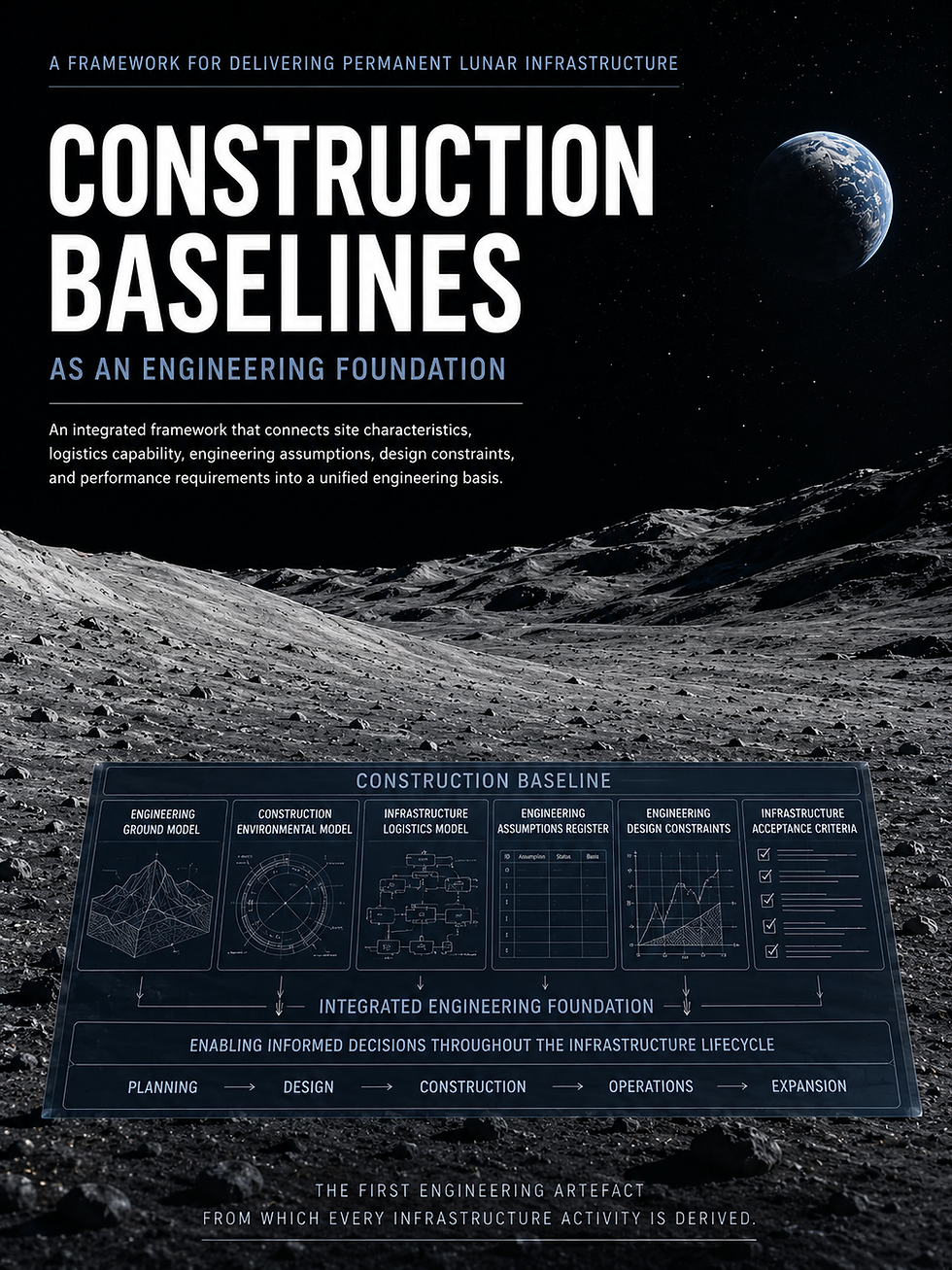
The proposed framework comprises six principal components: the Ground Model, the Environmental Model, the Infrastructure and Logistics Model, the Construction Assumptions Register, Design Constraints, and Acceptance Criteria. Although each serves a distinct engineering function, they should not be developed independently. Changes to one component frequently influence the validity of the others. For example, revisions to the Ground Model may affect construction methods, logistics planning, equipment selection, productivity estimates, design assumptions, and performance requirements. Similarly, modifications to operational constraints or logistics capability may require corresponding revisions to construction sequencing, design criteria, and acceptance requirements.

The relationship between these components is therefore iterative rather than sequential. As engineering knowledge evolves through site investigations, testing, construction activities, and operational experience, each model should be updated in a coordinated manner to preserve the consistency of the Construction Baseline. The integrity of the baseline depends not only on the quality of its individual components but also on the consistency of the relationships between them.
Engineering Ground Model
Every infrastructure project begins with an understanding of the ground upon which it will be constructed. For lunar infrastructure, this understanding extends beyond geological characterization and requires an engineering representation of the ground that supports design development, construction planning, infrastructure performance, and long-term operational reliability. The Engineering Ground Model provides that representation by integrating geological, geotechnical, and geophysical information into a framework that describes how the ground is expected to behave under anticipated construction and operational conditions.
The Engineering Ground Model characterizes the stratigraphic sequence, the spatial variability of regolith deposits, particle characteristics, density, strength, stiffness, compressibility, bearing capacity, excavation behavior, trafficability, slope stability, dust generation potential, and, where applicable, the in-situ stress conditions governing subsurface excavations. These engineering properties establish the basis for evaluating foundations, excavation methods, ground support systems, transportation corridors, underground openings, and the interaction between construction systems and the lunar surface.
Whereas conventional geological models, which primarily describe material origin, composition, and geological evolution, the Engineering Ground Model is developed to predict engineering response. Its principal objective is to quantify how the ground will perform when subjected to construction activities, operational loading, excavation, material handling, repeated traffic, and long-term service conditions. Consequently, the engineering value of the model is measured by its ability to support infrastructure decisions rather than by the completeness of geological interpretation.
Engineering confidence represents an equally important component of the model. Remote sensing products, laboratory testing of returned samples, terrestrial analogue investigations, numerical simulations, and future in situ investigations each provide information with different spatial coverage, resolution, and levels of confidence. The Engineering Ground Model, therefore, distinguishes measured parameters, interpreted conditions, and engineering assumptions while explicitly identifying the uncertainties that remain relevant to infrastructure development. This distinction enables engineering judgement to be exercised with a clear understanding of both the available evidence and its limitations.
The Engineering Ground Model is not a static representation of site conditions. As additional information becomes available through site investigations, construction observations, monitoring systems, and operational experience, the model evolves to improve its predictive capability and reduce engineering uncertainty. Maintaining this progression ensures that subsequent planning, design, and construction activities continue to rely on the most representative understanding of ground behavior available at each stage of infrastructure development.
Construction Environmental Model
The lunar environment establishes the boundary conditions within which infrastructure is planned, constructed, operated, and maintained. From an engineering perspective, environmental conditions are not simply external characteristics of the site; they are design inputs that influence construction methodology, equipment selection, material performance, productivity, operational reliability, and long-term infrastructure durability. The purpose of the Construction Environmental Model is to transform environmental information into engineering parameters that support infrastructure delivery.
The Construction Environmental Model characterizes the thermal regime, illumination cycles, radiation environment, vacuum conditions, dust transport mechanisms, electrostatic phenomena, seismic activity, local topography, and other environmental factors that directly influence construction activities. Rather than describing these conditions from a scientific perspective, the model evaluates their engineering significance and quantifies their influence on constructability, infrastructure performance, inspection, maintenance, and operational continuity.
Environmental conditions influence virtually every aspect of infrastructure delivery. Thermal cycles affect material behavior, dimensional stability, and equipment performance. Dust generation and transport influence excavation methods, material handling, mechanical systems, visibility, maintenance requirements, and operational efficiency. Illumination conditions constrain construction sequencing and inspection activities, while local topography influences site preparation, earthworks, transportation corridors, drainage concepts, where applicable, and the placement of permanent infrastructure. The Construction Environmental Model, therefore, establishes the engineering conditions under which construction systems are expected to function rather than simply documenting the characteristics of the lunar environment.
The model also identifies environmental constraints that govern project execution. Available operational windows, communication capability, power availability, access limitations, environmental hazards, and mission-specific operational restrictions directly affect construction productivity and should be incorporated into engineering planning from the earliest stages of project development. These factors influence construction schedules, equipment utilization, maintenance strategies, workforce requirements, contingency planning, and overall infrastructure resilience.
As additional engineering evidence becomes available through future missions, in situ monitoring, construction activities, and operational experience, the Construction Environmental Model should evolve in parallel with the other components of the Construction Baseline. Maintaining consistency between environmental conditions, ground behavior, logistics capability, and design assumptions ensures that the engineering framework continues to represent the actual conditions governing infrastructure delivery rather than isolated descriptions of the lunar environment.
Infrastructure Logistics Model
Infrastructure projects are delivered within the limits imposed by available logistics. Regardless of the quality of the engineering design, construction cannot proceed without the timely availability of transportation systems, equipment, energy, materials, consumables, maintenance capability, and operational support. Consequently, logistics should not be considered solely as an operational function but as an engineering discipline that directly influences constructability, productivity, project sequencing, and infrastructure feasibility.
The Infrastructure Logistics Model defines the physical and operational capabilities required to support infrastructure delivery. It characterizes the transportation architecture, launch cadence, payload limitations, equipment deployment, construction fleet capability, energy generation and distribution, consumable resources, maintenance systems, spare parts availability, storage capacity, and contingency resources necessary to sustain construction activities. Collectively, these elements establish the logistical capacity within which infrastructure can realistically be delivered.
Construction productivity is inseparable from logistical capability. Excavation rates, material transportation, foundation construction, structural assembly, regolith processing, equipment utilization, and maintenance activities are governed by the availability of supporting resources rather than by engineering design alone. A technically feasible construction method may become impractical if transportation capacity, available power, equipment reliability, or maintenance capability cannot sustain the required level of productivity. Accordingly, the Infrastructure Logistics Model provides the engineering basis for evaluating not only whether infrastructure can be constructed, but also how efficiently and reliably construction activities can be executed.
The model also establishes the dependencies between infrastructure assets. Construction rarely proceeds as a series of independent activities. Power systems, transportation corridors, communications, maintenance facilities, material storage areas, processing plants, and supporting utilities frequently determine when subsequent infrastructure elements can be developed. Representing these dependencies within the Construction Baseline enables engineering teams to evaluate construction sequencing, identify critical infrastructure interfaces, and assess the consequences of changes affecting supporting systems.
As infrastructure programs mature, the Infrastructure Logistics Model should evolve to reflect improvements in transportation capability, construction technologies, operational experience, equipment performance, and resource availability. Maintaining this model as part of the Construction Baseline ensures that engineering planning remains aligned with the practical capabilities available to deliver infrastructure rather than with theoretical assumptions regarding construction performance.
Engineering Assumptions Register
Engineering assumptions are an inherent component of every infrastructure project. During the early stages of project development, decisions frequently precede the availability of complete engineering information, requiring designers and planners to adopt assumptions regarding ground conditions, environmental behavior, equipment capability, construction methods, resource availability, and infrastructure performance. Although assumptions are necessary to advance project development, they also represent one of the principal sources of technical uncertainty within an infrastructure program.
The purpose of an Engineering Assumptions Register is to identify, document, evaluate, and progressively eliminate the assumptions that influence engineering decisions. Rather than functioning as an informal record of engineering judgement, the register provides a structured engineering control process that preserves the technical basis of each assumption, defines its relationship to project development, and establishes the conditions under which it can be verified, revised, or retired.
Engineering assumptions may relate to excavation productivity, equipment reliability, regolith properties, bearing capacity, trafficability, construction tolerances, structural behavior, material production rates, maintenance intervals, resource consumption, or operational performance. Regardless of their origin, assumptions should remain explicitly identified until sufficient engineering evidence supports their validation. Once incorporated into design calculations or construction planning without systematic review, unsupported assumptions have the potential to propagate uncertainty throughout the infrastructure program.
Each recorded assumption should define its technical justification, the engineering discipline responsible for its development, the supporting evidence, the potential consequences should the assumption prove invalid, the proposed method of verification, and the criteria governing its acceptance, modification, or retirement. Establishing these elements provides transparency throughout project development while enabling engineering teams to distinguish verified engineering inputs from provisional technical judgements.
The progressive reduction of assumptions represents an indicator of engineering maturity. As site investigations, prototype testing, construction observations, operational experience, and monitoring activities generate additional engineering evidence, assumptions should be systematically replaced by measured information or validated engineering parameters. Consequently, the Engineering Assumptions Register evolves from a record of uncertainty during conceptual development into a record of engineering confidence as infrastructure projects mature.
Engineering Design Constraints
Every infrastructure project is developed within a defined set of engineering constraints that establish the boundaries of technically feasible solutions. These constraints do not prescribe how infrastructure should be designed; rather, they define the conditions within which engineering decisions must be developed. Recognizing these constraints during the early stages of project development enables engineering teams to evaluate alternatives within a consistent framework while avoiding design solutions that cannot be constructed, operated, or maintained under the anticipated project conditions.
For lunar infrastructure, engineering design constraints extend beyond conventional structural or geotechnical considerations. Transportation capacity, payload dimensions, available power, communication architecture, construction fleet capability, operational windows, environmental exposure, maintenance philosophy, mission duration, safety requirements, planetary protection provisions, and resource availability collectively define the engineering envelope within which infrastructure systems must function. These constraints directly influence construction methodology, infrastructure configuration, equipment selection, material utilization, construction sequencing, and long-term operational performance.
Engineering Design Constraints differ fundamentally from engineering assumptions. Constraints represent established conditions imposed upon the project that define the limits of acceptable engineering solutions. Assumptions, by contrast, are provisional technical judgements adopted where sufficient engineering evidence is unavailable and remain subject to verification as additional information becomes available. Maintaining a clear distinction between these two concepts improves engineering consistency, strengthens technical traceability, and reduces ambiguity throughout project development.
Engineering constraints should also be regarded as dynamic rather than fixed. Advances in transportation capability, power generation, autonomous construction technologies, resource utilization, and operational experience may progressively expand the engineering solution space available to future infrastructure programs. Accordingly, Engineering Design Constraints should be periodically reassessed to ensure that the Construction Baseline continues to reflect the engineering conditions under which infrastructure is expected to be delivered rather than the limitations of earlier project phases.
By explicitly defining the engineering boundaries within which infrastructure development occurs, Engineering Design Constraints provide a consistent basis for evaluating alternative solutions, balancing competing project objectives, and maintaining technical coherence across multiple engineering disciplines throughout the evolution of the infrastructure program.
Infrastructure Acceptance Criteria
Infrastructure projects require clearly defined acceptance criteria before engineering design progresses beyond the conceptual stage. These criteria establish the measurable conditions that infrastructure assets must satisfy to demonstrate compliance with their intended function, performance requirements, operational objectives, and long-term service expectations. By defining these engineering outcomes at the outset of project development, the Construction Baseline provides a consistent basis for evaluating design alternatives, construction methodologies, verification activities, and operational readiness.
Infrastructure Acceptance Criteria should be directly related to the function of each infrastructure asset rather than to generic performance measures. Foundations require defined limits for bearing capacity, settlement, deformation, and long-term stability. Transportation corridors must satisfy requirements for trafficability, operational reliability, and maintainability. Excavations should demonstrate acceptable stability throughout construction and service life, while landing pads, utility corridors, processing facilities, and underground structures require performance criteria that reflect their respective engineering functions and operational demands.
The Construction Baseline should also establish the methods by which compliance with these criteria will be demonstrated. Verification may involve analytical modelling, laboratory testing, prototype demonstrations, in situ measurements, construction monitoring, commissioning activities, operational trials, or combinations thereof. The selected verification methods should reflect the importance of the infrastructure asset, the consequences of failure, the maturity of the available engineering information, and the level of residual uncertainty associated with the proposed design.
Infrastructure acceptance extends beyond structural adequacy. Long-term serviceability, durability, operational performance, inspectability, maintainability, reparability, commissioning requirements, and operational readiness collectively determine whether an infrastructure asset has achieved its intended engineering purpose. An asset that satisfies structural design criteria but cannot be reliably constructed, inspected, maintained, or operated cannot be considered fully compliant with its functional requirements.
Establishing Infrastructure Acceptance Criteria before detailed engineering begins fundamentally changes the design process. Rather than evaluating success after construction has been completed, engineering activities are developed against predefined performance objectives that remain consistent throughout planning, design, construction, commissioning, and operations. This approach provides a common engineering reference for designers, constructors, operators, owners, and future regulatory authorities while improving consistency across the entire infrastructure development process.
Maintaining the Construction Baseline
A Construction Baseline is established during the early stages of project development, but its engineering value depends upon its ability to evolve as new information becomes available. Infrastructure projects progressively replace assumptions with measured data, preliminary interpretations with validated engineering models, and conceptual design inputs with construction and operational evidence. Consequently, the Construction Baseline should be maintained as a dynamic engineering framework that reflects the current state of project knowledge while preserving the technical rationale supporting previous engineering decisions.
Engineering information continuously evolves throughout infrastructure development. Site investigations refine the understanding of ground conditions. Laboratory testing improves the characterization of engineering properties. Prototype demonstrations validate construction methodologies and equipment performance. Construction activities generate direct observations of infrastructure behavior, while operational experience provides evidence regarding long-term performance, maintenance requirements, and asset reliability. Each of these activities contributes engineering knowledge that should be systematically incorporated into the Construction Baseline.
Maintaining the baseline requires more than periodically updating individual engineering models. The relationships between the Engineering Ground Model, Construction Environmental Model, Infrastructure Logistics Model, Engineering Assumptions Register, Engineering Design Constraints, and Infrastructure Acceptance Criteria should remain internally consistent. Modifications to one component frequently influence the validity of the others. Updated ground conditions may alter excavation methods, logistics capability, productivity estimates, structural design criteria, construction sequencing, or acceptance requirements. Similarly, changes in transportation capability or available power may require revisions to equipment selection, construction methodology, operational planning, and infrastructure performance expectations.
The systematic retirement of engineering assumptions represents another essential aspect of baseline maintenance. Assumptions adopted during conceptual planning should not remain embedded within the engineering framework once they can be replaced by measured information or validated engineering evidence. The progressive reduction of assumptions, together with the corresponding increase in verified engineering knowledge, provides a direct indication of the technical maturity of the infrastructure program.
The Construction Baseline should therefore be regarded as a continuously evolving engineering framework rather than a static project deliverable. Its principal purpose is to preserve technical consistency as projects mature, integrate new engineering evidence across multiple disciplines, and ensure that infrastructure development continues to reflect the most representative understanding of the construction environment available at each stage of project delivery.
Implications for Lunar Infrastructure Programs
The adoption of Construction Baselines represents a shift in the manner by which lunar infrastructure programs are conceived, developed, and delivered. Rather than treating engineering disciplines as independent technical activities, the Construction Baseline establishes a common foundation that integrates site characterization, environmental conditions, logistics capability, engineering assumptions, design constraints, and infrastructure performance within a single engineering construct. This integration becomes increasingly important as lunar programs evolve from isolated demonstration missions toward permanent infrastructure systems composed of multiple assets, organizations, and stakeholders.
Infrastructure programs require engineering continuity. Decisions made during conceptual planning influence subsequent design development, procurement, construction sequencing, commissioning, operations, maintenance, and future expansion. Without a common engineering foundation, technical assumptions established during one phase of the program are frequently reinterpreted, modified, or replaced by individual disciplines, gradually introducing inconsistencies that become increasingly difficult to resolve as project complexity increases. A Construction Baseline preserves that continuity by ensuring that engineering decisions remain derived from a consistent body of technical information throughout infrastructure development.

A Construction Baseline establishes a common engineering foundation that integrates site characterization, environmental conditions, logistics capability, engineering assumptions, design constraints, and infrastructure acceptance criteria into a consistent framework for project delivery. By maintaining technical continuity throughout planning, design, construction, operations, and future expansion, Construction Baselines improve multidisciplinary integration, reduce engineering uncertainty, support the development of technical standards and governance frameworks, and enable the systematic delivery of permanent lunar infrastructure.
The proposed framework also establishes a common technical language for infrastructure delivery. Project owners, engineering organizations, contractors, operators, regulatory authorities, and commercial partners frequently evaluate infrastructure from different technical perspectives and according to different objectives. The Construction Baseline provides a shared engineering foundation that improves technical coordination, facilitates interface management, supports multidisciplinary design integration, and reduces ambiguity during project execution.
From a broader perspective, Construction Baselines provide the engineering foundation upon which future standards, technical specifications, contractual requirements, infrastructure certification, and construction governance frameworks may be systematically developed. Engineering standards rarely emerge independently; they evolve from engineering practices that have demonstrated consistency, repeatability, and technical value across multiple projects. By defining a structured approach to integrating engineering information, Construction Baselines establish one of the fundamental engineering artefacts required for the long-term standardization of lunar infrastructure delivery.
As infrastructure programs increase in scale, technical complexity, and international participation, the absence of a Construction Baseline will progressively limit the consistency and integration of engineering activities. Future lunar infrastructure will depend not only upon advances in technology, but also upon the engineering discipline required to transform scientific knowledge, engineering evidence, and operational experience into infrastructure capable of being designed, constructed, operated, expanded, and sustained over successive generations of development.
Conclusions
The transition from lunar exploration to permanent infrastructure requires more than advances in technology, scientific knowledge, or mission architecture. It requires engineering frameworks capable of integrating multidisciplinary information into a consistent basis for infrastructure planning, design, construction, verification, operations, and long-term asset management. As infrastructure systems increase in complexity, the absence of such frameworks will progressively become a limitation to project delivery rather than to technological capability.
This article has proposed the Construction Baseline as the engineering foundation for lunar infrastructure development. By integrating engineering characterization, logistical capability, project constraints, engineering assumptions, and infrastructure performance requirements within a single framework, the Construction Baseline establishes the technical continuity necessary to support infrastructure development from conceptual planning through long-term operations. More importantly, it provides a structured mechanism through which uncertainty can be progressively reduced as engineering evidence replaces assumptions throughout project development.

The significance of the Construction Baseline extends beyond individual projects. It establishes a common engineering foundation from which future standards, technical specifications, infrastructure assurance processes, contractual requirements, and construction governance frameworks can be systematically developed. As international participation and commercial investment continue to expand, engineering consistency will become increasingly important to ensure that infrastructure systems developed by different organizations remain technically compatible, interoperable, and capable of supporting long-term lunar development.
The Construction Baseline should therefore be regarded as the first engineering artefact of lunar infrastructure delivery. It transforms engineering information into an integrated foundation upon which infrastructure can be systematically planned, designed, constructed, verified, operated, and progressively expanded. Permanent lunar infrastructure will not be delivered by technology alone. It will be delivered by the engineering frameworks that transform knowledge into construction.
Roberto Moraes
Lunar Construction Strategist | Author | SpaceGeotech Founder


Comments