
More Than 50 Years of Lunar Penetration Tests. Is the Industry Asking the Right Engineering Question?
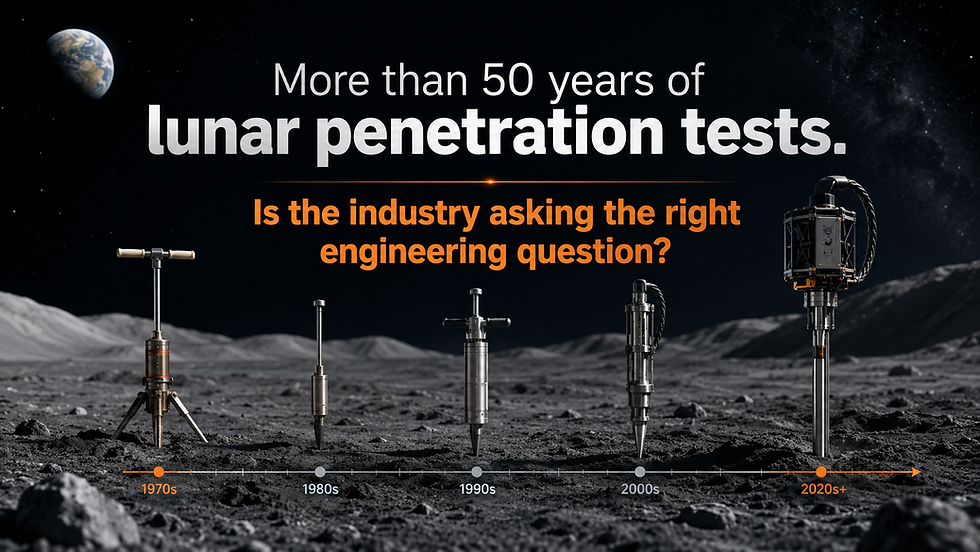
Lunar penetration response cannot be reduced to density alone. Density clearly matters, and it explains part of the depth trend, but the legacy Apollo and Soviet datasets, recent lunar-regolith syntheses, and modern granular penetration literature all point to additional controls: probe geometry, disturbance sensitivity, fabric/interlock, particle-size distribution, coarse fragments, and stress history. The strongest direct evidence is the Apollo/Lunokhod penetration envelope itself: at comparable depths, resistance varies substantially between sites and even within the Apollo 16 area, far more than a modest density contrast would predict.
Lunar science has done an extraordinary job explaining how the regolith formed. Lunar engineering must now determine how that same regolith will perform.
From the early Luna and Surveyor missions, through Apollo and Lunokhod, to today's Chang'e program and modern lunar simulant experiments, penetration testing has remained one of the most direct methods of investigating how the regolith responds to mechanical loading. These investigations have provided invaluable observations of penetration resistance, wheel sinkage, drilling performance, excavation behavior, density, strength, and trafficability. Together, they form the foundation of what we currently know about the engineering behavior of the lunar surface.

Despite six decades of penetration and ground-interaction measurements, no broadly adopted engineering framework currently exists for interpreting lunar mechanical state across missions.
More Than 50 Years of Lunar Penetration Measurements
The mechanical characterization of the lunar surface did not begin with the Apollo program. Since the mid-1960s, successive lunar missions have deployed a variety of instruments intended to investigate the physical response of the regolith during landing, penetration, excavation, drilling, and mobility operations. Although these missions pursued different scientific and operational objectives, together they constitute more than five decades of direct observations of the lunar near-surface.
The earliest mechanical observations were obtained during the Surveyor missions, where spacecraft landing behavior, footpad penetration, trenching experiments, and surface interactions provided the first estimates of regolith bearing characteristics. These measurements demonstrated that the lunar surface possessed sufficient strength to support landed spacecraft while also revealing significant variability in its shallow mechanical response.
The Soviet Luna program extended Apollo-era geotechnical observations through robotic drilling, core recovery, and in-situ penetration testing. Luna 16, Luna 20, and Luna 24 subsurface cores improved understanding of shallow regolith stratigraphy and drilling behavior, while the Lunokhod rovers acquired the largest robotic dataset of in-situ penetration measurements available from the lunar surface.
Between 1969 and 1972, the Apollo missions substantially increased the available mechanical database. Astronaut observations were complemented by dedicated soil mechanics experiments including cone penetrometers, Self-Recording Penetrometers (SRP), core tubes, trench excavations, drill stems, wheel trafficability experiments, bearing tests, and documented excavation performance. These investigations remain the only comprehensive in-situ engineering measurements obtained by humans on another planetary body.
Following the Apollo era, direct in-situ mechanical investigations became infrequent for several decades. More recently, China's Chang'e program has introduced new measurements of the shallow lunar subsurface using ground-penetrating radar, drilling operations, and in-situ sampling systems, providing additional insight into regolith structure and local mechanical conditions at previously unexplored landing sites.
In parallel with lunar exploration, terrestrial laboratories have developed increasingly sophisticated lunar regolith simulants to investigate compaction, excavation, penetration, wheel-soil interaction, drilling, sintering, additive manufacturing, and foundation behavior under controlled conditions. Although simulants cannot reproduce every aspect of natural lunar regolith, they have become an essential tool for engineering development and technology validation.
Taken together, these investigations represent more than fifty years of mechanical observations of the lunar surface acquired through multiple nations, missions, instruments, and testing methodologies.
What they provide is an invaluable record of how the lunar regolith has responded to penetration, excavation, loading, drilling, and mobility. What they do not automatically provide is a unified engineering framework for interpreting those observations for future infrastructure design.
What Have We Actually Been Explaining?
A review of the lunar penetration literature reveals a remarkably consistent pattern.
Regardless of the mission, instrument, or investigation method, the interpretation of penetration resistance has largely been discussed through a relatively common set of descriptors. Density, porosity, regolith maturity, impact gardening, thermal cycling, particle angularity, particle-size distribution, agglutinate content, and coarse fragments appear repeatedly as the principal factors governing the observed increase in resistance with depth.
These descriptors have proven fundamental to our understanding of lunar regolith evolution. Collectively, they explain how billions of years of meteoroid bombardment, seismic shaking, thermal cycling, and surface exposure progressively modified the lunar surface into the material encountered by Apollo astronauts and robotic missions. The scientific contribution of this body of work cannot be overstated. It represents one of the most comprehensive investigations ever conducted on the mechanical evolution of a planetary surface.
A subtle distinction, however, emerges when these studies are viewed from an engineering perspective.
Most investigations focus on explaining why the regolith exhibits its present characteristics. They seek to identify the geological and physical processes responsible for increasing density, modifying particle morphology, rearranging grains, and changing the near-surface structure over geological timescales.
Construction engineering asks a different question. Rather than asking how the regolith formed, engineers ultimately need to understand how it will perform when subjected to excavation, repeated loading, drilling, grading, compaction, foundation loading, or long-term operational traffic.
These two perspectives are complementary rather than competing. One explains the origin of the material. The other seeks to characterize its engineering behavior.
Scientific descriptors remain essential for understanding the regolith itself, but future engineering projects may require additional descriptors capable of translating those observations into quantities directly relevant to design, construction, and operational performance.
Engineers Ask Different Questions
Construction projects are not designed solely from material descriptions. They are designed from an understanding of how the ground will behave throughout its service life.
Whether constructing a transportation tunnel through fractured rock, designing a mine haul road, developing a dam foundation, or installing offshore infrastructure, geotechnical engineers routinely evaluate multiple aspects of ground behavior before design decisions are made. Density is one of those descriptors, but it is rarely considered sufficient by itself.
Engineering investigations seek to understand how the ground responds to loading, unloading, excavation, disturbance, vibration, cyclic loading, groundwater changes, and long-term operational demands. Questions naturally extend beyond material identification to include stiffness, compressibility, deformation characteristics, shear resistance, stress history, particle arrangement, constructability, and the sensitivity of the ground to repeated mechanical disturbance.
These parameters are not collected simply to describe the ground. They are obtained because they directly influence design decisions, construction methods, equipment selection, performance, risk, and long-term asset reliability.
The same engineering philosophy applies across infrastructure sectors. Tunnel boring machines are selected according to anticipated ground behavior rather than geological classification alone. Mine excavations are planned from expected rock and soil response under repeated loading. Dam foundations are assessed not only for strength, but also for deformation, stress redistribution, seepage, and long-term stability. Offshore developments consider cyclic loading, installation effects, and serviceability in addition to basic sediment classification.
In every case, the objective is the same: to translate geological information into engineering behavior.
How should decades of geological observations be translated into engineering descriptors capable of supporting excavation, foundations, roads, landing pads, underground construction, and long-term operational performance?
Apollo Was Already Speaking the Language of Engineering
Among the many observations produced during the Apollo soil mechanics investigations, one stands out for its simplicity.
One of the most remarkable observations from the Apollo soil mechanics program is the language used to describe the ground itself. The ground was described as hard, soft, harder, and rocky.
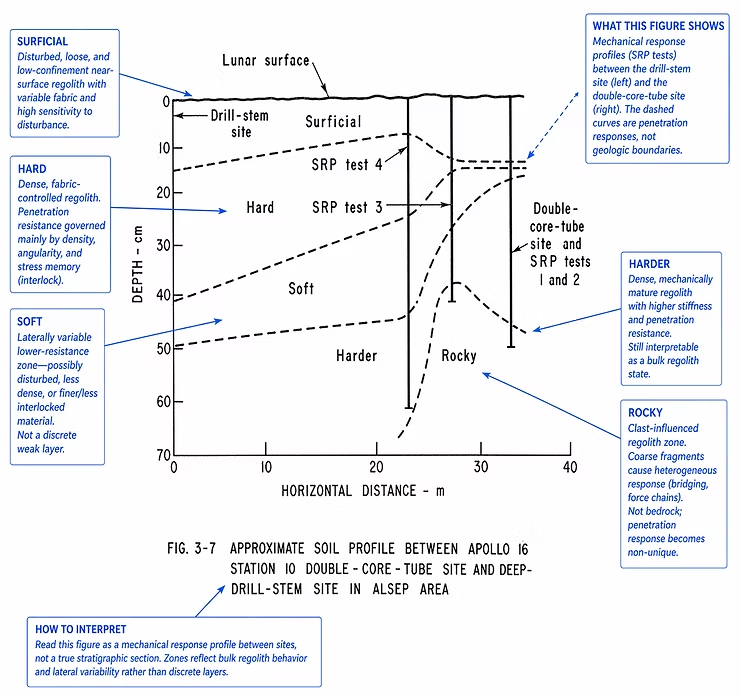
These are not density classes. They are engineering observations recorded during field operations.
The Apollo soil mechanics program documented how the lunar surface responded to penetration, drilling, trench excavation, wheel loading, astronaut mobility, and other forms of mechanical interaction. The resulting descriptions reflected the behavior encountered in the field rather than a purely geological classification of the regolith.
Terms such as hard or soft describe the response of the ground to applied loading. Likewise, trafficability, drill performance, excavation resistance, footprint depth, wheel sinkage, trench stability, and penetration resistance are all expressions of mechanical behavior. They describe how the regolith performs when subjected to engineering actions.
These observations do not replace geological descriptors such as density, maturity, particle-size distribution, or impact history. Instead, they complement them by providing direct evidence of ground response under operational conditions. Viewed from this perspective, the Apollo investigations were already moving beyond material description. They were documenting the engineering behavior of the lunar surface.
That observation becomes increasingly relevant as lunar activities shift from exploration toward infrastructure development. Future construction projects will depend not only on understanding what the regolith is, but also on predicting how it will respond to excavation, grading, repeated loading, foundation construction, vehicle traffic, and long-term operations.
The Apollo soil mechanics experiments demonstrated that these engineering questions are measurable. The next challenge is determining how those observations should be interpreted within a consistent engineering framework applicable across future lunar missions.
Additionally, the profile is not presented as a conventional geological section. Instead, the surface is interpreted through engineering observations such as "hard," "soft," "harder," and "rocky." These terms describe the mechanical response encountered during penetration, drilling, and excavation rather than discrete lithological units or density classes.
In other words, the Apollo investigators were documenting how the ground behaved under mechanical loading. The profile captures resistance, variability, and local response observed during field operations. It was never intended to represent a complete stratigraphic model of the lunar subsurface.
More importantly, the same engineering language appears repeatedly throughout the Apollo soil mechanics investigations. Penetration resistance, wheel mobility, drill performance, trench excavation, and astronaut observations consistently describe changes in mechanical response rather than changes in material type alone.
Even the historical Apollo data suggest that lunar surface characterization extends beyond density measurements. Mechanical response was already recognized as an essential component of understanding the regolith, although no unified engineering framework was proposed to interpret those observations across missions.
If Apollo engineers were already describing behavior, should future lunar infrastructure also be organized around engineering behavior rather than solely geological descriptors?
The Missing Engineering Layer
The distinction between geology and engineering is not a matter of disagreement. It is a matter of purpose.
Geology seeks to explain how the regolith reached its present condition. It reconstructs the processes that shaped the lunar surface over billions of years, including impact gardening, thermal cycling, particle evolution, and surface maturation. These investigations provide the scientific foundation upon which all future lunar activities depend.
Engineering begins where geology leaves off. Its objective is not to reconstruct the past, but to predict future performance.
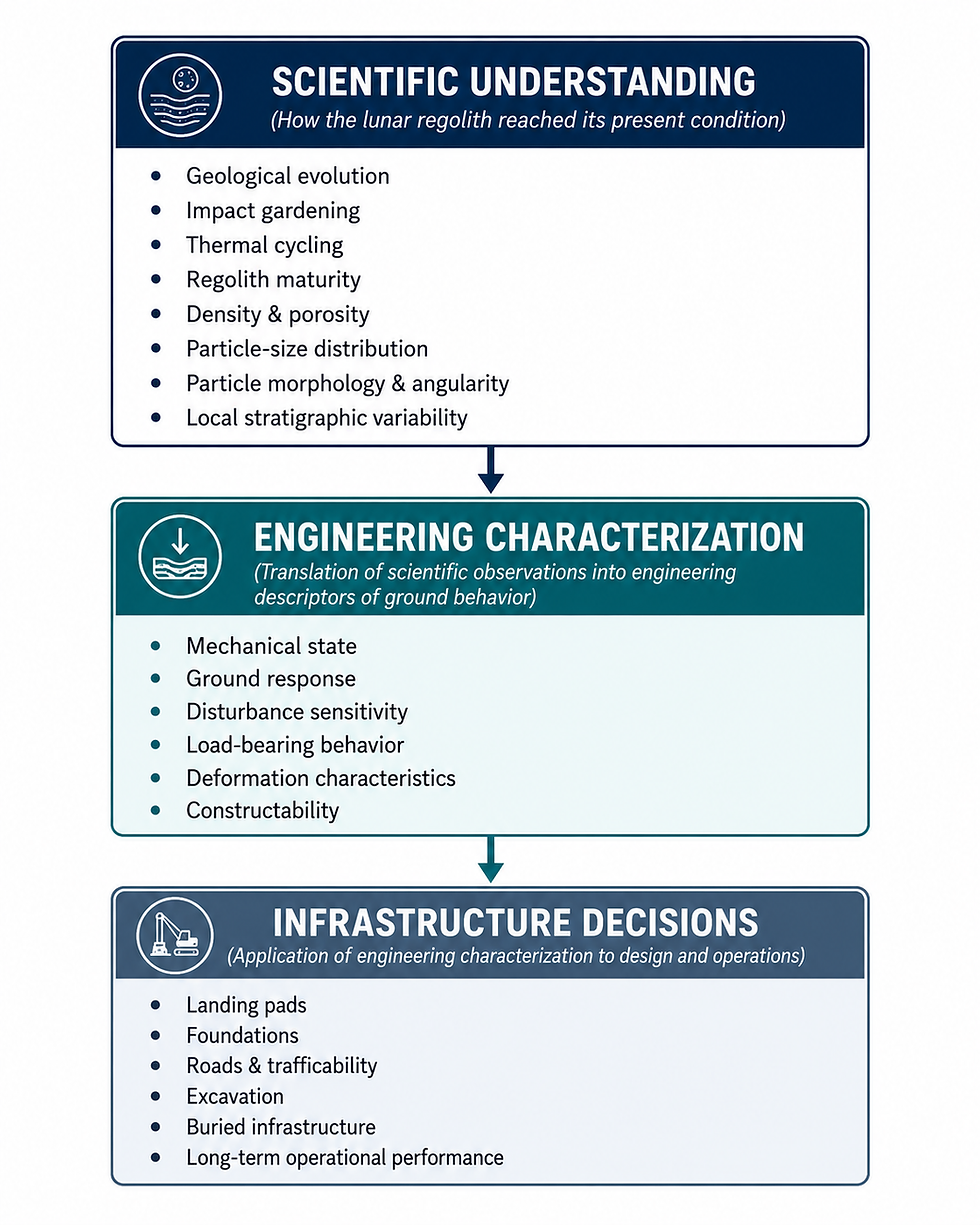
When a foundation is designed, an excavation is planned, or a haul road is constructed, engineers are ultimately concerned with how the ground will respond when disturbed, loaded, excavated, compacted, or repeatedly trafficked. Geological processes remain essential because they influence that behavior, but engineering decisions are based on the expected mechanical response of the ground rather than on its geological history alone.
This distinction has guided infrastructure development across every major geotechnical discipline. In tunneling, mining, dam engineering, offshore developments, and transportation infrastructure, geological characterization provides the context, while engineering characterization provides the basis for design.
Future landing pads, transportation corridors, excavation works, foundations, buried utilities, and underground infrastructure will all depend upon understanding how the regolith performs under operational conditions. These activities require engineering interpretations that connect scientific observations with construction-related behavior.
The remarkable body of lunar research accumulated over the past six decades has established an extraordinary understanding of how the regolith formed and how its physical properties vary across the lunar surface. The next stage of lunar development may be to translate that knowledge into engineering descriptors that support design, construction, operation, maintenance, and long-term infrastructure performance.
The Next Engineering Question
The remarkable legacy of Apollo, Luna, Lunokhod, Surveyor, Chang'e, and modern experimental research has provided an extraordinary body of knowledge about the lunar surface. Every mission has added another piece to the mechanical puzzle, and future missions will undoubtedly continue to improve our understanding of the regolith.
If lunar activities expand from scientific exploration toward sustained infrastructure development, the conversation naturally begins to change. The objective is no longer limited to understanding how the regolith formed, but increasingly includes understanding how it will perform throughout construction and operation.
Perhaps this is the next evolution of lunar geotechnical engineering. Not replacing the scientific descriptors that have served the community for decades, but complementing them with engineering descriptors capable of supporting excavation, trafficability, foundations, buried infrastructure, and long-term operational performance.
More than fifty years of lunar penetration investigations have provided an extraordinary engineering record. Perhaps the next major contribution will come not from measuring the regolith differently, but from interpreting its mechanical behavior differently.
Roberto Moraes
Lunar Construction Strategist |Author | SpaceGeotech Founder



Comments