
What Happens If We Build the Moon on Apollo Data?
Apollo was never a geotechnical investigation program. It was a reconnaissance mission with limited soil mechanics objectives: understand landing interaction, mobility, and basic surface behavior.
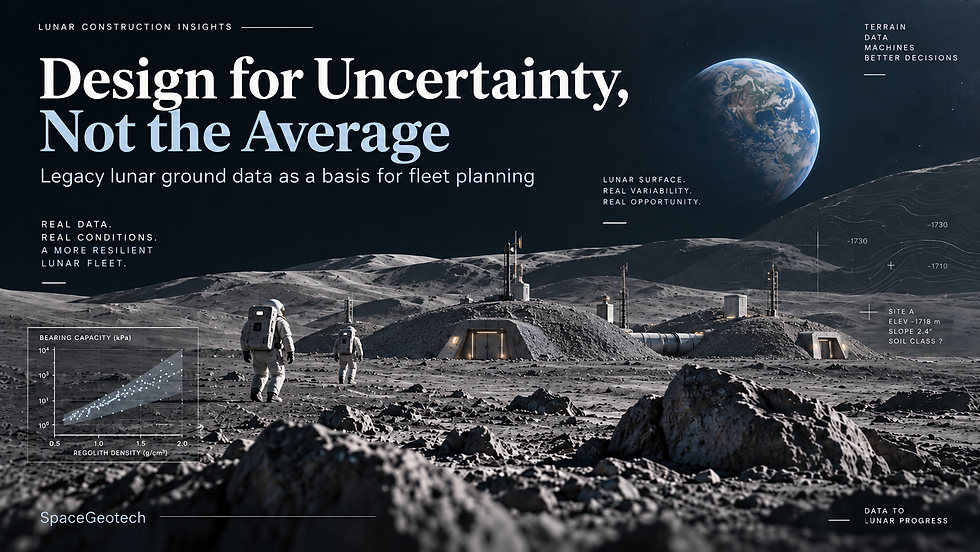
The data we rely on today was collected through footprints, rover tracks, core tubes, and a handful of penetration tests. No controlled investigation grid. No variability mapping. No design envelope.
Six landing sites.
Shallow depth.
Localized conditions.
And yet, this dataset is now being used, implicitly, to justify:
excavation systems,
trafficability models,
foundation sizing,
compaction strategies,
even long-term infrastructure such as habitats and power systems.
Because the Moon is not a uniform surface. It is a stratified, evolving, and highly variable regolith system, formed by stochastic impact processes and layered deposition mechanisms. Even within a single Apollo site, density, strength, and porosity vary with depth and laterally at meter scale.
Now extend that variability across mare basalts, highland breccias, pyroclastic deposits, basin ejecta blankets.
There is no basis to assume consistency. And yet space industry does.

The current engineering posture across the space sector reflects a consistent assumption set that is rarely stated explicitly but is embedded in design decisions coming out of NASA programs, commercial initiatives such as Blue Origin, Astrolab, Lunar Outpost, and emerging ISRU-focused ventures like Interlune. Excavation systems are being conceived with implicit expectations of predictable cutting resistance; mobility architectures are being developed on the premise of uniform bearing response; and structural concepts, including landing pads and surface power units, are being advanced under the assumption that settlement behavior can be extrapolated from Apollo-era observations and treated as transferable across sites.
These positions are not supported by the data.
They are anchored to a dataset that was never structured, acquired, or validated for design. The Apollo soil mechanics investigations were explicitly aimed at understanding interaction, variability, and feasibility, not at establishing parameter envelopes for infrastructure deployment. The measurements were localized, shallow, and opportunistic, derived from footprints, rover tracks, penetrometer readings, and discrete core samples. Even within those constraints, the results already showed variability in density, strength, and porosity with both depth and lateral position.
Recent missions reinforce, rather than reduce, this uncertainty. At the Chang’e 6 mission landing site, in situ radar data identified a distinct stratigraphic transition within the first three meters: an upper layer of fine, highly weathered regolith overlying a coarser, less processed ejecta unit. This is not a gradual density increase with depth; it is a mechanical discontinuity that directly affects excavation energy, tool wear, penetration resistance, and load transfer mechanisms. Any system designed on the assumption of a continuous medium is immediately exposed to unaccounted variability.
The prevailing interpretation of regolith as a material, defined primarily by particle size distribution and bulk density, is inadequate. The available evidence points to a state-controlled system, where mechanical response is governed by stress history, fabric evolution, and cumulative processing rather than by composition alone. Apollo data, when examined in detail, already indicate increasing density and strength with depth, high relative densities below the near-surface layer, and significant sensitivity to disturbance. These are signatures of a material whose behavior cannot be reduced to a single representative profile.
The Apollo dataset remains the only calibrated in situ geotechnical reference available. It is internally consistent, empirically grounded, and indispensable as a baseline. However, its scope is limited to specific locations, shallow depths, and mission-driven observations. It provides a framework for interpretation, not a basis for generalization. Treating it as a complete design dataset extends it beyond its validity.
Under these conditions, any mischaracterization of ground response propagates directly into engineering outcomes. Bearing capacity estimates become unconstrained, settlement predictions lose reliability, excavation energy requirements are misjudged, trafficability models diverge from actual performance, and dust generation remains poorly bounded. Each of these parameters is not independent; they are coupled through the mechanical state of the regolith and its evolution under loading and disturbance.
The Core Error: Treating Regolith as a Material Instead of a State
The dominant approach across current lunar programs remains rooted in a terrestrial mindset: define the material, replicate it, test it, and design against it. In practice, this has translated into simulant-driven development, where particle size distribution, mineralogy, and bulk density are treated as the primary descriptors of regolith behavior.
Facilities supporting programs at NASA, as well as test campaigns continue to rely on this framework to qualify excavation tools, mobility systems, and surface interaction models.
This approach is structurally flawed.
Regolith behavior is not governed solely by what the particles are, but by how they have evolved mechanically over time. The lunar surface is the product of continuous impact processing, thermal cycling, particle comminution, and electrostatic interactions, all acting under extremely low confinement. These processes do not simply generate a granular material; they generate a fabric with memory. That memory controls stiffness, penetration resistance, dilatancy, and load transfer.

Recent subsurface observations reinforce the same conclusion. At the Chang’e 6 mission site, the transition from fine, weathered regolith to coarse ejecta within a shallow depth interval is not simply a geological boundary; it represents a change in stiffness, strength, and excavation response. Treating both layers as equivalent because they fall under the same “regolith” classification obscures the actual mechanics controlling performance.
The implication for engineering is direct. Systems designed against a nominal “lunar soil” implicitly assume that:
cutting resistance can be predicted from density and grading,
trafficability can be generalized across terrains,
compaction produces consistent improvement,
bearing capacity follows a transferable profile with depth.
None of these assumptions hold without accounting for stress history and confinement.
Under lunar gravity, effective stresses are an order of magnitude lower than terrestrial conditions for the same depth. This fundamentally alters contact mechanics, particle rearrangement, and the mobilization of shear strength. A near-surface layer that appears dense in absolute terms may still behave as a loose structure due to low confinement. Conversely, deeper layers may exhibit high stiffness not because of material differences, but because of accumulated overburden and impact-induced densification over geological time.
This is where the distinction becomes unavoidable: regolith is not a material parameter problem; it is a state parameter problem.
The OCR* framework formalizes this distinction by expressing the ratio between the maximum historical stress experienced by the regolith fabric and the current in situ stress under lunar conditions. It provides a direct link between observable behavior, penetration resistance, stiffness, and dilatancy, and the underlying mechanical state. Without such a parameter, the same material can be interpreted as loose, dense, weak, or strong depending solely on the test method and boundary conditions imposed during simulation.
The continued reliance on simulants that reproduce particle size but not stress history leads to a systematic misrepresentation of behavior. Earth-based testbeds, even when conducted in vacuum or reduced gravity analog conditions, cannot replicate the cumulative effects of impact gardening and long-term fabric evolution. As a result, they validate equipment performance within the constraints of the test environment, but not the interaction with the actual lunar ground.
Apollo Data: What It Actually Provides, and Where It Stops
Apollo established that the lunar surface behaves as a granular medium with frictional resistance comparable to silty sands, with cohesion emerging at low confinement due to particle interlocking and surface forces. It confirmed that density increases with depth, that near-surface layers can be loose despite similar grading, and that strength parameters evolve rapidly within the first tens of centimeters. Penetration resistance, footprint depths, and rover performance gave direct evidence of load-bearing capacity at the scale of operations conducted during the missions.
It also confirmed variability.
Even within a single landing site, soil response changed across short distances. Crater rims, slopes, and intercrater plains exhibited different densities and strengths. Core tubes revealed layered stratigraphy, not a uniform deposit, with discrete units reflecting successive depositional and reworking events. These observations are often acknowledged but rarely carried through into design assumptions.
Where Apollo becomes limited is precisely where engineering begins.
The dataset is shallow. Most direct measurements are constrained to the upper tens of centimeters, with extrapolations beyond one meter inferred rather than measured. There is no continuous profiling of strength, stiffness, or density with depth at the resolution required for foundation design, excavation planning, or load cycling analysis.
The dataset is localized. Six landing sites, selected for safety and mission constraints, do not represent the range of geological provinces across the Moon. Mare basalts, highland breccias, pyroclastic deposits, and basin ejecta were not sampled systematically. There is no statistical basis for transferring parameters from one site to another.
The dataset is operational, not parametric. Apollo measurements were derived from interaction, astronaut movement, rover traffic, and simple penetration devices, not from controlled geotechnical testing frameworks. There are no standardized CPT profiles, no triaxial test series under representative confinement, no cyclic loading tests, and no long-duration settlement observations.
The dataset is static. It captures response at a moment in time, under limited loading conditions. It does not address how regolith evolves under repeated loading, thermal cycling, or sustained structural weight. For infrastructure, these are governing conditions.
Despite these limitations, Apollo data is routinely extended beyond its scope. Bearing capacity values are generalized, settlement behavior is assumed to scale with depth, and excavation energy is inferred from limited penetration resistance data. This is not a misuse of the data itself; it is a misinterpretation of its applicability.
The distinction is critical.
Apollo provides a baseline for understanding behavior. It does not provide a design envelope. It establishes that the ground can support loads, that mobility is feasible, and that excavation is possible. It does not quantify how these processes vary across terrains, depths, or repeated operations. The consequence of overlooking this boundary is subtle but systematic. Designs appear consistent because they are anchored to a common reference, but that reference lacks the variability needed to test robustness. What emerges is not a conservative design approach, but an unconstrained one, where uncertainty is not reduced, only unaccounted for.
The Apollo dataset remains indispensable. It is the only dataset that directly ties mechanical response to lunar conditions. But its role is to inform interpretation, not to replace investigation.
Orbit-Based Site Selection: The Engineering Blind Spot
Site selection for upcoming missions is being driven primarily by orbital datasets. Illumination, slope, thermal environment, line-of-sight communications, and proximity to volatiles dominate the decision framework. This is evident in the current Artemis discussions led by NASA and reinforced by parallel assessments across industry and academia.
From an exploration standpoint, the approach is coherent.
From an engineering standpoint, it is incomplete.
Orbital data does not provide mechanical properties. High-resolution imagery can resolve boulder distribution, surface roughness, and slope gradients. Spectroscopy can infer mineralogy. Radar can indicate subsurface layering in broad terms. None of these datasets directly quantify bearing capacity, stiffness, compressibility, or excavation resistance.
A surface that appears smooth from orbit may correspond to a loose, dust-generative L1 layer with low confinement and poor load-bearing capacity. Conversely, a rougher terrain may overlie a denser, overconsolidated structure capable of supporting significant loads with minimal settlement. There is no direct correlation between optical appearance and mechanical performance.

The introduction of subsurface radar in recent missions provides a glimpse of what is missing. At the Chang’e 6 mission site, radar data revealed a layered structure within the upper three meters, distinguishing between a fine-grained weathered unit and an underlying coarse ejecta layer. This information is valuable, but it remains indirect. It does not translate into design parameters without calibration against mechanical testing.
It is important to stress that no current orbital dataset resolves:
strength profiles with depth,
stiffness and deformation modulus,
cyclic degradation under repeated loading,
excavation energy requirements,
trafficability limits under varying loads.
The absence of this information forces engineering assumptions to fill the gap. Those assumptions are then embedded into system design, propagated through simulations, and eventually treated as validated conditions. At no stage are they reconciled with measured ground behavior at the target site.
In terrestrial projects, this separation does not exist. Geological mapping and remote sensing define the context, but design proceeds only after intrusive investigation establishes the mechanical profile. Boreholes, in situ testing, and geophysical surveys are used to constrain uncertainty before any foundation, excavation, or load-bearing system is finalized.
On the Moon, the sequence is reversed. Sites are selected. Systems are designed. Ground behavior is assumed.
The missing link is not technological capability; it is prioritization. Without a dedicated geotechnical investigation phase embedded in site selection, the current framework cannot transition from exploration to infrastructure with controlled risk.
Mismatches between expected and actual performance
Excavation and ISRU systems are currently developed against simulants calibrated by particle size and bulk density. Cutting tools, bucket wheels, augers, and drilling systems are therefore tuned to a resistance envelope that assumes continuity with depth and consistency across sites. Apollo penetration data already show increasing resistance with depth and sensitivity to local density variations. What is not captured is how rapidly that resistance can change when transitioning from a reworked surface layer to a denser or coarser unit. The Chang’e-6 subsurface profile confirms that such transitions can occur within meters. The immediate implication is operational: energy demand, tool wear, and advance rates will not scale linearly with depth, and systems designed for steady-state excavation will encounter step changes in performance.
Mobility and road systems are exposed at the surface, where confinement is lowest and variability is highest. The near-surface layer behaves as a loose granular deposit despite having the same particle size distribution as deeper layers. Apollo observations of footprint depths and rover tracks already indicated variability in porosity and strength at meter scale. Translating that into operational terms, a rover traversing a visually uniform terrain can encounter alternating zones of higher sinkage, increased rolling resistance, and elevated dust mobilization. Without a defined mechanical profile, traction models and energy budgets become site-dependent rather than system-dependent.
Compaction and ground improvement are being approached using terrestrial logic: apply energy, reduce void ratio, increase stiffness. On the Moon, the absence of pore fluids, the role of particle interlocking, and the influence of electrostatic and van der Waals forces alter the response. Near-surface material can densify, but the degree to which compaction translates into predictable stiffness gain remains unquantified. More critically, the relationship between compaction effort and resulting OCR*-state is not defined. Without that link, compaction becomes an operation without a measurable target.
Foundations and structural systems, including landing pads and surface power units, are currently referenced against generalized bearing capacity values derived from Apollo interpretations. Those values reflect localized conditions and limited loading scenarios. They do not capture variability across terrains or the effect of repeated loading cycles from landings, thermal expansion, or operational activity. Settlement predictions based on averaged density-depth profiles overlook the presence of layered structures and local heterogeneity. The result is not necessarily immediate failure, but differential response, tilting, stress redistribution, and long-term performance degradation.
Dust generation and surface interaction cut across all systems. Fine fractions identified in Apollo samples dominate near-surface behavior and are highly mobile under disturbance. The interaction between mechanical loading, particle detachment, and electrostatic effects is not fully captured in current models. Excavation, traffic, and plume impingement all contribute to dust mobilization, which in turn affects equipment reliability, thermal systems, and optical performance. Without a state-based understanding of the surface layer, dust remains treated as a nuisance rather than a coupled mechanical response.
Across all these systems, the same pattern emerges. Design inputs are derived from a simplified representation of regolith, while actual performance depends on a layered, state-dependent medium. The mismatch is not uniform; it varies with depth, location, and loading condition. That variability is not bounded in current designs.
Testbeds and Simulants: Validation Without Representativeness
The current qualification pathway for lunar surface systems is built around terrestrial testbeds. Vacuum chambers, reduced gravity offloading rigs, and controlled environments are introduced to approximate lunar conditions.
The limitation is not in the quality of the simulants; it is in what they cannot reproduce. Lunar regolith is the result of billions of years of impact processing, comminution, and reworking under low confinement. The fabric that emerges from this history, particle interlocking, agglutinate formation, contact bonding, and density evolution, is not recreated by crushing terrestrial basalts and placing them in a test box. Simulants can match grading curves and specific gravity. They do not carry stress history.

A simulant prepared at a target density does not replicate the same contact network or stiffness response as a naturally evolved regolith at the same density. The difference becomes apparent in penetration resistance, dilatancy, and load transfer mechanisms.
Testbeds also impose boundary conditions that diverge from the lunar environment. Gravity is reduced artificially, not intrinsically. Confinement is applied through overburden or mechanical constraint, not through the gradual accumulation of stress over geological time. Cyclic loading histories, which would govern infrastructure performance, are not represented. The result is a controlled environment where variability is minimized, precisely the opposite of the field conditions being approximated.
This leads to a consistent outcome: systems perform as expected within the test environment. Excavators achieve target production rates, mobility platforms meet traction requirements, and compaction trials show measurable improvement. These results are valid within the constraints of the test. They do not establish that the same performance will be achieved under lunar conditions where the governing parameter is not reproduced.

The distinction between equipment validation and ground validation is often blurred.
Testbeds validate mechanisms, cutting efficiency, wheel-soil interaction under defined loads, structural response to imposed forces. They do not validate the ground model. When the ground model is assumed rather than measured, the test becomes a confirmation of the assumption rather than an independent verification.
The absence of stress history in simulants is the central gap. Without it, there is no way to reproduce OCR*-controlled behavior. A simulant can be prepared at a given density, but it cannot be assigned a meaningful ratio between historical maximum stress and current confinement. As a result, two test conditions that appear identical in terms of density and grading may correspond to entirely different mechanical states in the lunar environment.
Attempts to compensate through empirical calibration, adjusting friction angles, cohesion values, or modulus parameters, introduce another layer of uncertainty. These parameters are tuned to match observed behavior in the testbed, not to reflect intrinsic properties of the lunar ground. When transferred into design models, they carry the bias of the test environment.
The implication is not that testbeds should be abandoned. They are essential for system development. The implication is that their role must be defined correctly. They provide performance envelopes under controlled conditions. They do not define the ground.
Without a calibrated link between simulant behavior and in situ measurements, the current validation pathway remains incomplete.
The transition from landing site to construction site requires a different filter
At present, sites are discussed in terms of slopes, hazard density, and operational constraints, with implicit assumptions that ground performance will fall within acceptable limits. That assumption is not supported by any in situ mechanical dataset at the candidate locations. The Apollo sites, often used as analogues, were selected under different constraints and do not represent the range of terrains now being considered.
A structured approach requires introducing a geotechnical suitability lens, one that integrates OCR*, regolith zoning, and geological context into a coherent assessment of ground performance.
Within this framework, certain regions begin to emerge as more favorable for early infrastructure, not because they are easier to access, but because their ground conditions are more likely to support predictable performance. Mature mare surfaces, where regolith has undergone prolonged reworking and densification, are expected to exhibit higher OCR* states at shallow depth, translating into improved bearing capacity and reduced settlement variability. In contrast, highland regions, with their brecciated fabric and block-rich deposits, introduce greater heterogeneity and less predictable load transfer mechanisms.
Pyroclastic terrains, while attractive for resource extraction due to their fine-grained nature, present a different challenge. Low confinement combined with potentially lower bonding states can result in reduced near-surface strength and higher susceptibility to disturbance. These conditions are not prohibitive, but they require a different design approach, one that is not currently reflected in system development.
The discussion around regions such as the Mons Plateau reflects this shift. Identified as a candidate with potentially favorable conditions, it represents an example where geological interpretation suggests improved mechanical behavior, but where no in situ verification exists. The same applies across the broader set of Artemis candidate sites.
The absence of measured parameters forces all sites into a similar category: operationally viable, mechanically undefined.
This has direct implications for infrastructure planning. Without a quantified understanding of bearing capacity, settlement, and excavation response, there is no basis to differentiate between sites beyond surface-level criteria. Systems must therefore be designed either conservatively, to accommodate worst-case conditions across all संभावable terrains, or optimistically, assuming that actual conditions will align with expectations.
Neither approach supports efficient development.
A geotechnical suitability index, grounded in OCR* and zoning, provides a path to differentiate sites based on expected performance. It allows for the identification of locations where early infrastructure can be deployed with reduced uncertainty, while highlighting areas where additional investigation is required before committing to construction.
This does not replace existing selection criteria. It complements them by introducing the one variable that governs all surface interaction: ground response.
From Assumptions to Measured Ground
The current trajectory across lunar programs, public and commercial, has advanced hardware, mission architectures, and operational concepts at a pace that is not matched by the characterization of the ground those systems depend on. The reliance on Apollo data, orbital interpretation, and simulant-based validation has created a coherent narrative of feasibility, but not a controlled understanding of performance.
The analysis across excavation, mobility, foundations, and site selection leads to a consistent position. The limitation is not the absence of engineering capability; it is the absence of measured parameters tied to the actual mechanical state of the regolith at the locations where infrastructure is intended to be deployed.
Apollo remains the only calibrated in situ reference. It established that the lunar surface could support operations, that mobility is achievable, and that excavation is possible. It also demonstrated variability with depth and location, and the sensitivity of response to confinement and fabric. Extending those findings beyond their scope, without additional measurement, introduces uncertainty that is not quantified within current designs.
Simulant-based testbeds validate system functionality under controlled conditions. They do not reproduce the stress history or fabric that governs in situ response.
The introduction of OCR* and regolith zoning offers a framework to organize and interpret ground behavior, but it requires calibration through direct measurement. Without that calibration, the framework remains conceptual.
A transition from exploration to infrastructure requires a change in sequence. Ground investigation must be treated as a primary mission objective, not as a secondary consideration. The measurements required, penetration resistance, stiffness profiles, density variation, excavation response, are well defined within geotechnical practice. What is missing is their acquisition under lunar conditions at the sites being selected for development.
Until that step is taken, design decisions will continue to rely on inferred conditions. The systems being developed will function, but their performance envelope will remain dependent on assumptions rather than bounded by data.
Roberto de Moraes
Author | SpaceGeotech Founder


Comments