
Do Not Size the Lunar Construction Fleet for the Average Ground
Updated: Sep 17
What kind of lunar construction fleet can tolerate the ground variability already visible in the legacy record?
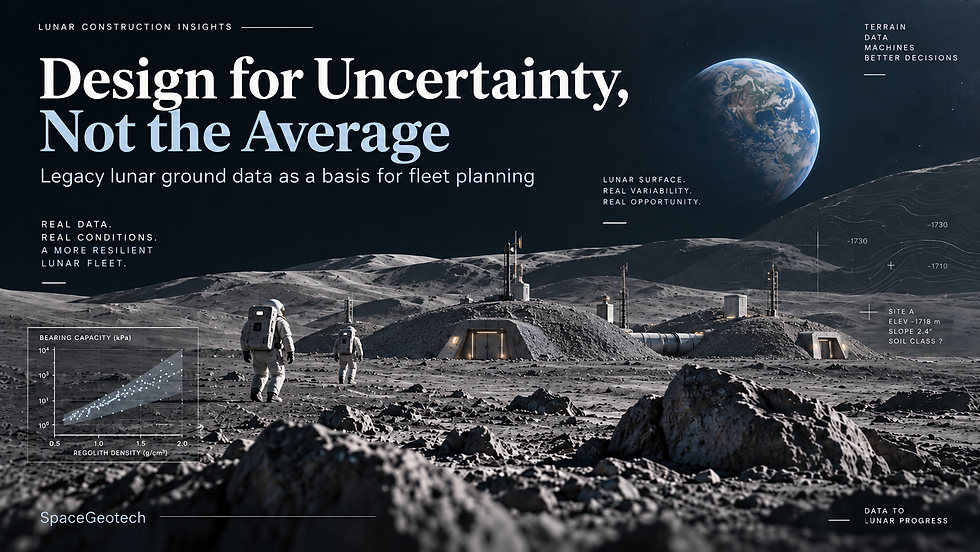
Lunar construction equipment is often discussed in terms of nominal capability: excavation rate, payload, power demand, autonomy, slope capability, or distance travelled.
On an Earth jobsite, contractors do not select an excavator, dozer, loader or haul fleet against one average ground condition and assume production will remain constant. Equipment selection is made against a range of expected conditions, because ground variability immediately affects traction, digging resistance, cycle time, payload, wear, access, recovery and ultimately schedule.
The available lunar record is already sufficient to make one point clear: the construction fleet should not be configured around a single representative regolith condition.
The working database used for this article contains 186 legacy and modern records assembled from Surveyor, Apollo, Luna, Lunar Reconnaissance Orbiter, Chang’e and Chandrayaan sources. Apollo accounts for 129 of those records, so the evidence base is not spatially balanced. Nevertheless, it includes direct observations relevant to construction: penetrometer measurements, rover tracks, footprints, trenching, drill stems, spacecraft touchdown response, boulder tracks and shear testing.
Evidence in working database | Records |
Apollo | 129 |
Luna | 29 |
Surveyor | 12 |
LRO | 12 |
Chang’e | 3 |
Chandrayaan | 1 |
Total | 186 |
The important point is not the number of records by itself. It is the range of mechanical responses represented by them.
Apollo and Lunokhod penetration observations, for example, show substantial variation with terrain, depth and disturbance. Reported shallow penetration resistance ranges from below about 200 kPa in loose, disturbed or slope material to more than 2,500 kPa in denser, relatively undisturbed ground. The Apollo soil-mechanics program itself relied on several different interactions with the ground, including spacecraft touchdown, astronaut footprints, tools, core tubes and the Self-Recording Penetrometer, because no single measurement adequately described lunar surface behavior.
A machine optimized for easy excavation in loose surface material may not retain the same production rate when it encounters denser material, a resistant horizon, a buried block, or ground repeatedly trafficked and disturbed by other equipment. Conversely, a machine sized for the bounding condition may carry unnecessary mass, power demand and complexity through most of its operating life.
Typically, the contractor may start with a hydraulic excavator and bucket, but the method can change quickly when the face changes. A ripper may be required. A breaker may be introduced. Haul-unit numbers may change because loading time has increased. Dozer support may be added. Access may have to be reworked. Production assumptions are revised as actual ground conditions become known.
The lunar version of that problem is harder because every additional attachment, machine, spare component and kilowatt has a launch and logistics penalty. That leads to a different fleet-design situation, and leading us to across what range of ground conditions can this fleet continue to deliver useful production without requiring another major piece of equipment from Earth?
That is the construction problem this article addresses.
What the legacy record means for fleet planning?
Legacy observation | Construction implication | Fleet question |
Large variation in penetration resistance | Excavation effort may vary significantly between work fronts | Does the primary excavation tool retain useful production across the expected range? |
Softer/disturbed ground versus denser undisturbed ground | Traction and support conditions will not be uniform | Can the same chassis maintain mobility and drawbar performance? |
Rover tracks and repeated surface interaction | Traffic itself changes the working surface | How does the fleet perform after repeated passes and disturbance? |
Boulder and clast evidence | Excavation may be interrupted by discrete obstructions | Is there an alternate tool or removal method? |
Limited spatial coverage of legacy measurements | Actual site conditions will retain substantial uncertainty | How much adaptability and redundancy should be carried in the initial fleet? |
This is not yet a fleet-sizing calculation. The legacy data are too heterogeneous for that, and many of the quantities needed for equipment design, cutting force, drawbar pull, wear rate, excavation energy, clast frequency and sustained cycle efficiency, were not measured consistently during the legacy missions.
But the data are already useful for something more immediate:
They define the reason not to design a lunar construction fleet around a single nominal ground condition.
The first fleet should be selected not only for production capability, but for its tolerance to uncertainty.
That may ultimately favor interchangeable tools, functional redundancy, staged deployment, or a combination of all three.
What the Legacy Lunar Record Actually Tells Us
The legacy record does not support the idea of one uniform lunar operating condition. The working database used for this article contains 186 records drawn from Surveyor, Apollo, Luna, LRO, Chang’e and Chandrayaan sources. It is strongly weighted toward Apollo, which accounts for about 69% of the records. That bias matters: this is not a statistically uniform map of the Moon, and it should not be treated as one.
Mission group | Records | Share of database |
Apollo | 129 | 69% |
Luna | 29 | 16% |
Surveyor | 12 | 6% |
LRO | 12 | 6% |
Chang’e | 3 | 2% |
Chandrayaan | 1 | <1% |
Total | 186 | 100% |
What makes the record useful for construction planning is not simply the number of measurements. It is the variety of ways the lunar surface was physically disturbed, loaded, penetrated or observed.
The database includes 44 drive-tube records, 27 direct-shear tests, 25 penetrometer records, 22 drill-stem observations, 13 spacecraft-touchdown analyses, 12 boulder-track records, 8 rover-track observations, 8 footprint analyses and 7 trench experiments.
Construction-relevant evidence | Records | What it tells us operationally |
Drive tubes | 44 | Resistance changes with depth and local material condition |
Direct shear | 27 | Shear response is not represented by one fixed material value |
Penetrometers | 25 | Near-surface mechanical resistance varies between locations and conditions |
Drill stems | 22 | Subsurface interaction changes as penetration progresses |
Spacecraft touchdown | 13 | Ground response under concentrated loading is variable |
Boulder tracks | 12 | Discrete blocks and local bearing response matter |
Rover tracks | 8 | Trafficability and surface disturbance are site dependent |
Footprint analysis | 8 | Very shallow ground response is not uniform |
Trench experiments | 7 | Excavation behavior and sidewall response vary locally |
The Apollo 17 soil-mechanics work is a good example. Boulder tracks, footprint observations and penetration measurements were used because different types of ground interaction revealed different aspects of the surface response. The Apollo 17 report itself notes that the variability inferred from boulder-track observations was more reliable than the absolute friction-angle values derived from them.
More recent missions reinforce the same point from a different direction. Chang’e-6 radar data identified a two-layer shallow subsurface structure at its landing site, with an upper weathered layer and a coarser lower ejecta layer extending to about 3 m depth. That does not define conditions elsewhere on the Moon, but it is another direct indication that construction equipment should expect vertical changes in material character rather than a single homogeneous working layer.
The legacy data also come from different evidence classes: in-situ measurements, returned-sample laboratory testing and remote observations. These should not be blended indiscriminately. Laboratory shear tests, for example, provide useful bounds, but sample preparation, specimen size and test stress conditions can alter the response relative to undisturbed lunar ground.
Translate the Data into Construction Ground Cases
A contractor does not need a perfect geological model before asking a practical question:
What range of ground response must the construction fleet be able to tolerate?
That is the purpose of the following cases. They are not geological units, lunar stratigraphic classes, or design soil parameters. They are construction-planning cases derived from the range of responses already present in the legacy record. Their purpose is to test equipment strategy, production assumptions, redundancy, and recovery requirements against conditions that a lunar construction campaign may reasonably encounter.
The working database shows why this is necessary. In-situ records alone include bulk densities ranging approximately from 0.8 to 2.29 g/cm³, reported friction angles from very low values up to about 55°, and substantial variation in penetration, bearing response, trench behavior, rover interaction, and subsurface density with depth. These values come from different missions, test methods, terrains, and depths and should not be combined into one universal lunar material model. They are useful here because collectively they demonstrate a broad operating envelope.
Construction case | Legacy evidence used as indication | Likely jobsite consequence | Fleet implication |
1. Loose/easily worked surface material | Low-density and low-strength observations, shallow disturbed material, trenching and footprint evidence | Relatively easy cutting, but potentially greater wheel slip, rutting, material loss and poor support under repeated traffic | Excavation may be easy while mobility and haul efficiency become controlling |
2. Nominal trafficable ground | Apollo and Lunokhod rover-track observations; many reported in-situ densities around the mid-range of the database | Routine excavation and mobility with predictable production if traffic routes are controlled | Baseline fleet configuration and nominal production case |
3. Dense/higher-resistance material | Apollo 15 and 16 penetrometer observations; higher-density drill-stem intervals; friction angles approaching approximately 50° in some records | Increased digging resistance, slower penetration, greater traction and power demand, more passes | Tool capability and available drawbar/power reserve become important |
4. Weak-support/disturbed ground | Crater-wall observations, shallow disturbed ground, low bearing-response records and repeatedly trafficked material | Sinkage, rutting, loss of traction, reduced payload efficiency, possible requirement for route preparation | Low ground pressure, traction management, alternate routing or ground treatment may govern |
5. Clast/boulder-interrupted ground | Boulder-track observations and mission descriptions of coarse fragments and blocks | Interrupted excavation, bucket/tool obstruction, local rerouting, production losses and potential immobilization | Alternate tools, handling capability and recovery provisions required |
6. Highly variable/ uncertain ground | Strong spatial and vertical variability across the database combined with limited site coverage | Frequent departure from nominal production assumptions and possible changes in construction method | Adaptability, modularity and functional redundancy become fleet-level requirements |
The distinction between these cases matters because easy excavation does not necessarily mean easy construction.
Loose material may reduce cutting resistance but increase wheel slip or rutting. Denser material may provide better support for traffic while increasing excavation effort. A buried block may occupy only a small part of the work area but stop a machine that has no alternative tool. A weak patch along a haul route may reduce the production of an otherwise capable excavation system. This is normal construction behavior.
Case 1 - Loose/easily worked surface material
The legacy record contains several observations consistent with relatively loose or weak shallow material. Apollo 14 trench data in the working database, for example, include low reported cohesion on the order of 0.03–0.10 kPa, while Surveyor and Apollo observations document disturbed near-surface material through trenching, footprints and spacecraft interaction.
From a fleet perspective, this should not automatically be considered the easiest case.
A bucket may penetrate readily, but the machine must still generate traction. Repeated wheel or track passes may disturb the surface further. Haul routes can rut, and material may be difficult to control during loading, pushing or stockpile:
Keep in mind:
Can the machine excavate, carry, maneuver and repeatedly traffic the same working area without production deteriorating?
Case 2 - Nominal trafficable ground
The database contains rover-track observations from Apollo and Lunokhod missions that provide a useful middle case for construction planning.
Apollo rover-track records include reported bulk densities approximately in the 1.6–1.9 g/cm³ range in several entries, together with friction-angle estimates broadly in the mid-30s to low-40s degrees. These should not be treated as a lunar design specification, but they provide a useful reference condition against which a nominal fleet can be tested.
This is the condition under which the advertised or modeled fleet production rate might reasonably be established.
It should be the baseline, not the bounding case.
Case 3 - Dense/higher-resistance material
The database also records clearly stronger responses.
Apollo 15 penetrometer records include bulk density near 1.97 g/cm³, friction-angle estimates approaching 48-52°, and cohesion around 2 kPa in some entries. Apollo 16 records similarly include shallow densities around 2.0 g/cm³, while Apollo 15 drill-stem data include values exceeding 2.1 g/cm³.
Again, these values should not be converted directly into excavation force without additional engineering work.
But they are enough to consider the following condition:
What happens to production when the excavator leaves its nominal operating condition and encounters substantially more resistant ground?
In a transit corridor project, that change might trigger a ripper, breaker, different bucket, reduced cut depth, additional passes, or another machine. Lunar equipment needs an equivalent response strategy.
Case 4 - Weak-support/disturbed ground
In this case, construction fleets must also tolerate the opposite problem. The database distinguishes crater slopes, disturbed surfaces, rover tracks, and other locally modified ground conditions. Some remote boulder-track analyses also indicate relatively low near-surface bearing-capacity estimates in specific terrain cases. Again, the direct construction consequence is mobility rather than excavation.
A machine capable of developing sufficient digging force is of little use if it cannot develop the required traction or if haul units begin to sink, slip or rut the route.
This case therefore tests:
ground pressure;
wheel or track loading;
slip tolerance;
payload reduction;
route preparation; and
recovery strategy.
This is one reason to evaluate a lunar construction fleet as a system, not as a set of individual machine specifications.
Case 5 - Clast/boulder-interrupted ground
The LRO boulder-track records contained in the database provide evidence of blocks interacting with the lunar surface across highland, mare and pyroclastic terrains. These observations do not provide a complete construction-scale boulder-frequency model. They should not be used to predict how many blocks an excavator will encounter per cubic meter.
They do establish something operationally important; however, discrete obstructions exist and cannot be represented by an average regolith property.
On some jobsite, even a small number of oversized blocks can dominate production. They can prevent bucket penetration, damage tools, interfere with grading, require secondary handling, or force a change in excavation sequence.
A lunar fleet that assumes homogeneous granular excavation may therefore be vulnerable to a relatively small number of obstruction events.
Case 6 - Highly variable/uncertain ground
The final case is perhaps the most important.
The database combines information from different missions, terrains, depths and measurement methods, while actual construction sites will initially have far less direct information than terrestrial contractors normally expect. The construction fleet therefore has to operate not only against known variability but against uncertainty in the variability itself.
This is the case that tests whether the fleet has enough adaptability to continue working when the actual ground falls outside the original production assumption.
That could mean:
changing attachments;
reducing excavation depth per pass;
rerouting haul traffic;
introducing local ground preparation;
reallocating machines;
changing work sequence; or
temporarily accepting lower production while the condition is investigated.
From legacy data to a fleet test envelope
The value of these cases is not that they predict exactly what a future lunar site will contain. Their value is that they give equipment developers and construction planners something more useful than an average property value: a set of operating conditions against which the proposed fleet can be challenged.
The next step is therefore straightforward. Take the proposed fleet and test it against all six cases.
If the same configuration remains productive across the envelope, the fleet may be sufficiently robust. If it does not, the project must decide whether the answer is:
more capable equipment, interchangeable tools, additional machines, staged deployment, or deliberate redundancy. That is where fleet strategy begins.
Test the Fleet Against the Ground, Not the Average
A lunar construction fleet should not be judged only by whether it performs well under a nominal regolith condition. The more useful test is whether the same machine, or the same fleet architecture, remains productive when the ground moves away from the nominal case.
That is standard construction thinking. On mega projects, equipment performance is rarely governed by the average condition. It is governed by the sections of the job where traction drops, excavation resistance increases, haul routes deteriorate, oversized material appears, or cycle times begin to drift away from the estimate.
The legacy lunar record already shows enough variability to justify the same approach.
So, what should be tested?
Fleet performance variable | What changes when the ground changes | Why it matters to the project |
Traction | Wheel slip, drawbar performance and maneuverability can deteriorate in loose or disturbed ground | A machine may have sufficient cutting force but still be unable to transmit it effectively to the ground |
Excavation effort | Denser or more resistant material increases penetration and cutting demand | Production rate may fall while power and wear increase |
Grading efficiency | Variable material response affects blade loading, pass depth and surface finish | More passes may be required to achieve line, level and acceptance tolerances |
Payload | Weak support, traction limits or increased loading time may reduce practical payload | Nominal payload capacity may not equal useful production payload |
Sinkage | Softer or disturbed ground can increase wheel or track penetration | Mobility losses can propagate into haulage, access and recovery problems |
Number of passes | Harder ground or reduced cut depth can increase the number of excavation or grading cycles | Direct impact on time, energy and equipment utilization |
Power demand | Cutting, traction and repeated passes can raise instantaneous and cumulative energy demand | Fleet productivity may become limited by power availability rather than machine capacity |
Productivity | Cycle time, queuing, reduced payload, additional passes and rehandling compound | The project production rate can be much lower than the machine's advertised rate |
Recovery requirement | Weak ground, obstructions or mechanical overload can immobilize equipment | Recovery capability becomes part of fleet design, not an emergency afterthought |
The point is not to assign a single value to each item from the legacy database. The database does not support that level of equipment design directly. Instead, is to use the observed range of lunar ground responses to ask whether the proposed fleet stays inside a useful operating envelope.
A nominal machine can still be the wrong construction machine
Suppose a lunar excavator is designed around a nominal production rate of 100 tonnes per hour. That number tells us very little by itself. However, on a real jobsite, the useful thoughts to consider would be:
At what ground resistance does that production begin to fall materially?
How much wheel slip occurs while the cutting tool is loaded?
Does the machine still achieve full bucket fill?
How many additional passes are required in denser material?
What happens to power consumption?
Can the haul fleet keep up?
What happens when a block interrupts the cut?
Can the machine recover itself?
If production falls by 30 or 50 percent, does the overall construction sequence still work. This is the difference between machine performance and construction performance. A machine can successfully excavate lunar regolith and still be poorly suited to the construction program.
The terrestrial analogy is straightforward
In earthworks project, a contractor may estimate production assuming:
a certain bucket fill factor;
a certain cycle time;
a certain haul distance;
a certain material class;
a certain number of passes;
and a certain equipment availability.
If the ground changes, those assumptions move together.
A harder excavation face may reduce bucket fill and increase loading time. That delays the haul units. The trucks queue differently. The dozer receives material at another rate. Fuel or power use rises. The planned daily quantity is missed.
It is important to know that no individual machine necessarily "failed." Therefore, the production system changed, and the same logic should be applied to lunar construction.
From machine capability to operating envelope
For fleet planning, each equipment item should be evaluated against the six construction ground cases defined earlier. A simple screening matrix could look like this:
Ground case | Traction | Excavation effort | Grading efficiency | Power demand | Recovery exposure | Expected production response |
Loose/easily worked | Potentially limiting | Low | Moderate | Low–Moderate | Moderate | Excavation may be fast, mobility may govern |
Nominal trafficable | Baseline | Baseline | Baseline | Baseline | Low | Nominal production case |
Dense/ higher resistance | Generally favorable | High | Reduced | High | Moderate | Lower cut depth and slower cycles likely |
Weak-support/ disturbed | Low | Low–Moderate | Reduced | Moderate | High | Mobility and haul efficiency may dominate |
Clast/ boulder interrupted | Variable | Local peaks | Poor locally | Peak demand possible | High | Production becomes intermittent |
Highly variable/ uncertain | Uncertain | Uncertain | Uncertain | Uncertain | High | Requires adaptability and contingency |
This is the kind of table that begins to tell a construction manager whether the fleet architecture is robust. A machine that produces 100 tonnes per hour under favorable conditions but drops to 20 tonnes per hour when traction deteriorates or excavation resistance increases may be less valuable to the project than a machine that consistently delivers 50 tonnes per hour across a much wider operating envelope.
The second machine may give the project a more reliable schedule. That is especially important on the Moon, where replacing a machine, mobilizing a specialist attachment or adding a recovery vehicle is not comparable to calling another subcontractor or mobilizing another excavator from a nearby yard.
Recovery belongs inside the fleet strategy
One of the most practical implications is recovery. In infrastructure projects, immobilized equipment can often be recovered with another dozer, excavator, crane, winch, service truck or specialist contractor.
The Moon may not have that potential; therefore:
Can machines self-recover?
Can one machine recover another?
Are there suitable tow points and recovery interfaces?
Is sufficient traction available to extract a disabled unit?
Can an attachment be changed in the field?
Can another machine temporarily take over the critical function?
A better basis for fleet selection
The equipment comparison should therefore move away from a single performance number and toward a broader construction envelope. A useful fleet-selection basis would compare:
Nominal production + ground tolerance + adaptability + degraded-mode production + recovery capability + redundancy.
This changes the procurement conversation. It means, the "best" machine is not necessarily the machine with the highest nominal output.
For a first lunar construction campaign, the more valuable machine may be the one that continues producing when the ground, the production sequence, or the operating assumptions change. That is the fleet we should be designing for.
The Missing Numbers Still Matter
The legacy lunar record is valuable, but it is not a complete fleet-design dataset. It already supports an important construction conclusion: the lunar surface should not be treated as one uniform operating condition. The database contains enough evidence to define a preliminary ground-response envelope and to build practical planning cases for excavation, mobility, grading and recovery. That does not mean it contains all of the quantities needed to design and size a construction fleet.
In the selected construction-relevant subset of the working database, 114 records covering penetrometers, drive tubes, drill stems, rover tracks, footprint analyses and trench experiments, the evidence coverage is uneven. Bulk density is reported in 93 records and depth in 71. Friction angle is available in 36 records and cohesion in 34. By contrast, bearing capacity appears in only 6 records, and applied force in only 9.
It means the legacy record is far stronger at describing ground conditions than at defining machine performance.
What the dataset supports, and what it does not:
Parameter in selected construction-relevant records | Usable records | Appropriate construction use |
Bulk density | 93 | Preliminary indication of material state and variability |
Depth | 71 | Context for vertical variation and working depth |
Friction angle | 36 | Preliminary indication of shear-strength characteristics |
Cohesion | 34 | Preliminary indication of shear-strength characteristics |
Applied force | 9 | Limited direct evidence of ground/tool interaction |
Bearing capacity | 6 | Sparse evidence; insufficient as a standalone basis for fleet design |
That is enough to justify the operating-envelope approach, however, it is not enough to derive a construction fleet in the same way one would design a terrestrial earthworks operation from a well-developed site investigation and a mature production database.

Bulk density, depth, friction angle and cohesion help establish the range of material conditions that a fleet may encounter. They are useful for defining preliminary construction cases and for identifying where excavation resistance, support conditions or material response may depart from the nominal case. They should not, however, be treated as direct substitutes for equipment-performance parameters.
A value of bulk density or friction angle does not, by itself, establish cutting force, drawbar pull, excavation energy, wheel slip, tool wear, bucket fill, cycle time or sustained production. Those quantities depend on the interaction between the ground, the machine, the tool, the operating method and the work geometry.
This is where lunar fleet studies need to remain on the safety side. It is tempting to take a small number of regolith properties, insert them into an analytical model, and produce a single excavation force or production rate. Such calculations can be useful for preliminary screening, but their precision should not exceed the quality of the underlying evidence.
For a contractor, the available ground data help define what the equipment must be capable of encountering. They do not yet define how a particular machine will perform when it encounters it.

Several fleet-design quantities therefore remain to be established through dedicated testing and site-specific verification. These include:
excavation/cutting resistance;
available drawbar pull and traction reserve;
rolling resistance and repeated-traffic response;
excavation energy;
tool and component wear;
practical bucket/blade fill;
clast/obstruction frequency and handling requirements;
sustained cycle efficiency;
recovery loads and recovery capability.
These are the necessary inputs to fleet sizing, power allocation, productivity, maintenance planning, redundancy, and schedule. The existing database should therefore be used for what it can support with confidence: defining a preliminary ground-response envelope and identifying the range of conditions that the construction fleet must tolerate. The missing equipment-response parameters then become fleet-design verification requirements.
This creates a clear separation between two stages of the engineering process:
Legacy data define the range of ground conditions.
Fleet testing defines the machine response within that range.
That separation is important because it prevents the legacy record from being asked to provide information it was never intended to measure. Therefore, for early lunar construction, the most defensible approach is to use Apollo, Surveyor, Luna, and later mission evidence to bound the preliminary construction cases, then reproduce those conditions as closely as practicable in terrestrial testbeds and analog sites. Excavation force, traction, power demand, wear, cycle efficiency, and recovery performance can then be measured directly with the proposed equipment.
As site-specific lunar data become available, the preliminary envelope can be narrowed and the fleet model updated. This represents a stronger engineering basis than selecting one representative regolith condition and designing the fleet around it.
Design for Uncertainty, Not the Average
The legacy lunar record is already good enough to establish one practical point: the ground will not behave as one uniform material, and fleet performance should not be based on a single nominal condition.
For contractors, designers, equipment developers and program teams, that changes the basis of the decision overall.
The objective is not to identify one “representative” regolith condition and optimize the fleet around it. The objective is to define the range of ground response that can reasonably affect the works, understand where the available evidence is strong and where it remains incomplete, and then verify that the proposed equipment can continue operating across that range.
On terrestrial projects, changed ground conditions do not automatically constitute failure. They become a construction problem when the method, equipment or project controls cannot absorb them. The same principle applies on the Moon, except that the consequences of a poor fleet decision are much greater. Additional plant cannot simply be mobilized from another project. Specialist equipment may be months away. Recovery capacity, redundancy and adaptability therefore have to be considered before deployment, not after a production problem develops.
The available legacy data should be used accordingly. They provide the starting envelope for construction planning. They do not remove the need for site-specific investigation, equipment-ground testing, production trials and progressive verification as the actual site becomes better characterized.
For decision-making teams, this has a direct implication: fleet selection should be treated as a construction-risk decision, not only as an equipment-performance decision. Nominal tonnes per hour, payload, power and autonomy remain important, but they are only part of the basis. Sustained production under off-nominal ground conditions, recovery capability, functional overlap, and the ability to change method without stopping the work are equally important.
The fleet that performs best under one favorable condition may not be the fleet that delivers the project.
The lunar fleet should not be optimized only for the expected ground condition. It should be configured to keep construction moving when the ground is not what was expected.
For the first lunar construction campaigns, that is the standard that matters.
Bibliography
Carter, T. G. (1992). Prediction and uncertainties in geological engineering and rock mass characterization assessment. Proceedings of the 4th Italian Rock Mechanics Conference, Turin, Italy, Paper 1, pp. 1.1–1.22.
Mitchell, J. K., Houston, W. N., Carrier, W. D., & Costes, N. C. (1973). “Apollo 15 Soil Mechanics Investigation.” In Apollo 15 Preliminary Science Report, NASA SP-289, pp. 8-1–8-23.
Zhang, Z., Ding, C., Su, Y., Shen, S., Lu, W., Soldovieri, F., Xiao, Z., Zeng, X., Du, W., Liu, Y., Jiang, C., Gennarelli, G., Catapano, I., Dai, S., Feng, J., Wang, Y., Liu, J., & Li, C. (2025). “Subsoil structure at the Chang’E-6 landing site revealed by in-situ Lunar Regolith Penetrating Radar.” Communications Earth & Environment, 6, 640. https://doi.org/10.1038/s43247-025-02631-4
SpaceGeotech Lunar Regolith Database. Working compilation used in this study, comprising Surveyor, Apollo, Luna, LRO, Chang’e and Chandrayaan mission data and associated published sources. The construction-focused subset used in this article contains 114 records covering penetrometer, drive-tube, drill-stem, rover-track, footprint, and trench observations.
L. Gasteiner, N. Murdoch, and O. D’Angelo, “An Open Database of Lunar Regolith and Simulants Properties,”
2026. invited contribution for the Journal for Numerical and Analytical Methods in Geomechanics [preprint: ArXiv:
2602.03829].
L. GASTEINER, N. MURDOCH, and O. D’ANGELO, “Dataset for the Lunar Regolith Database,” May 2026. https://entrepot.recherche.data.gouv.fr/dataset.xhtml?persistentId=doi:10.57745/NTSZ8G
NOTE: The SpaceGeotech Lunar Regolith Database is a working compilation rather than a substitute for the original mission and publication records. Where individual values are used for design or verification, the originating source should be consulted directly.
Roberto Moraes
Lunar Construction Strategist | Author | SpaceGeotech


Comments