
NASA Can Compact Lunar Regolith. But What Does “Compacted” Mean?
Updated: 2 hours ago
The material most likely to require controlled compaction in early lunar infrastructure is often not undisturbed regolith. It is regolith that has been excavated, screened, hauled, dumped, spread, or backfilled.

Recent work presented through the Lunar Surface Innovation Consortium (LSIC) shows that NASA is making real progress in robotic regolith compaction. Systems such as PACT and STOMP are being developed to densify lunar regolith simulants using tamping and vibratory compaction methods. The work has included vacuum testing, testing different simulant materials, measuring bulk density and penetration resistance, scaling equipment, and early consideration of production rates.
It shows that compact robotic systems can alter the state of loose granular material in a controlled and measurable way. For construction, however, that is only part of the problem.
On a civil works project, the fact that a roller has made several passes and increased density does not, by itself, establish that the ground is ready for use. The engineer still needs to know what material was placed, how it was placed, the lift thickness, the depth of improvement, the final geometry, the mechanical response of the compacted layer, and whether the completed work meets the requirements of the asset it is intended to support.
Reworked regolith may be used in a haul road, a protective berm, a reactor foundation pad, trench backfill, a solar tower foundation, or a large shielding earthwork. Each application places different demands on the ground.
A haul road may be governed by rutting and repeated trafficking. A foundation may be governed by settlement and stiffness uniformity. A berm may be governed by geometry and slope performance. Trench backfill must control support and post-construction settlement. A shielding structure may involve large volumes of placed material where production rate, layer control, and final geometry become as important as density.
So the question is no longer simply whether lunar regolith can be compacted.
This leads us to move forward and start thinking about the next move:
What measurable ground condition must be achieved before the work can be accepted for its intended use?
First, Distinguish in-situ Regolith from Regolith Reworked Lunar Fill
Before discussing compaction, it helps to separate two very different construction conditions: undisturbed regolith in place and regolith that has been excavated, handled, and placed again.
The Apollo record is important here because it does not support the idea of a uniformly loose soil profile. Measurements from drive tubes and drill stems show that bulk density commonly increases with depth, although the values vary between sites and sampling methods. Apollo 16 is a good example. Several drive-tube records show near-surface densities around 1.4 to 1.6 g/cm³, increasing to roughly 1.6 to 1.8 g/cm³ in deeper intervals. Drill-stem data from the same mission show a similar progression, from about 1.46 g/cm³ in the upper 20 cm to about 1.75 g/cm³ at depths of 1.5 to 2.2 m.
Apollo 17 provides further evidence that the ground state changes with depth. Drive-tube records include values around 1.6 g/cm³ in the upper 22 cm and about 1.73 g/cm³ between 22 and 70 cm. Other Apollo 17 cores reached even higher densities, depending on location and sampling interval.
Those data should not be turned into a single universal lunar density profile. The Apollo sites were limited, and the measurements reflect different terrains, sampling methods, local disturbance, and test procedures. The useful takeaway is simpler: in-situ lunar regolith already has a depth-dependent state shaped by its geological history.
That state includes particle packing, fabric, interlocking, burial history, and repeated disturbance from impact gardening. Whatever terminology is eventually adopted, it is not equivalent to freshly dumped loose fill. Therefore, once that material is excavated, the condition changes.
A trench excavator, dozer, loader, bucket wheel, or other regolith-handling system will disturb the original particle arrangement. Screening can change the grading. Hauling and dumping can produce segregation. Spreading creates a new fabric and density state. If the material is then used to form a berm, road embankment, shielding layer, foundation pad, or trench backfill, the engineer is no longer dealing with the original ground.
The material has become reworked lunar fill.
This is extremely important because much of the early demand for compaction is likely to arise from construction itself. For example:
excavated regolith placed in successive lifts to form a protective berm;
cut material reused to build an access haul road;
processed material placed beneath a reactor or other critical foundation;
trench spoil returned around buried cables or utilities;
bulk regolith placed as shielding around or above a surface structure.
In each case, the original in-situ condition has been disturbed, and a new earthwork has been created. This leads to an important change in how the compaction problem should be framed. This way, we do not need to simply understand how the regolith can become dense. Instead, the goal is to investigate how and what condition the material is in when it is placed, what condition the completed fill must achieve, and what construction process will reliably get it there.
The construction starting point is therefore the material condition after excavation, processing, transport, dumping, and spreading. That is where lift thickness, particle-size distribution, segregation, placement method, compactive effort, and verification become important. Material that was competent before excavation is not automatically accepted when reused in an embankment or structural fill. Once it is disturbed and placed again, it must meet the requirements of the new earthwork.
Undisturbed regolith is a ground condition. Reworked regolith is a construction material and should be treated as such.
Density is a Measurement, Not a Construction Requirement
NASA work shows a clear increase in density and penetration resistance with compaction. That is useful evidence because it confirms that the material state is changing under repeated passes. The reported results include relative densities of about 85% after several vibratory passes and values exceeding 100% after further compaction.
Those numbers need to be interpreted in the way they would be on an earthworks project.
Relative density is a reference index for granular material. It describes the position of the current density between laboratory-defined loose and dense states. It is useful for comparing material condition, but it is not itself a measure of whether a road, foundation pad, berm, or trench backfill is fit for service.
A value greater than 100% relative density is therefore not evidence that the material has become “more than fully compacted.” It means that the density achieved during the test exceeded the maximum density established by the reference procedure. That can happen, particularly when the compaction mechanism produces a packing arrangement that the laboratory reference test did not reproduce.
From a construction perspective, that result matters because it says something about both the reference method and the material. If the field or prototype process can consistently exceed the adopted maximum density, the reference state may need review before it is used as a specification or acceptance limit. In this case, the more important issue is what the achieved density means for earthwork performance.
A haul road does not perform because it has reached a particular relative density. It performs because the compacted layer can carry repeated traffic without excessive rutting, shear deformation, or loss of surface geometry. A foundation pad must provide acceptable settlement and stiffness uniformity. A berm must retain its geometry and remain stable. Trench backfill must support the installed system and limit post-placement settlement. Thus, density can be part of the control process, but it needs to be linked to those responses.
This is standard practice in terrestrial construction. Density is often used because it is practical to measure and because experience has established relationships between density, material type, compactive effort, and field performance. Even then, critical earthworks commonly rely on more than one indicator. Stiffness, penetration resistance, proof loading, settlement response, or other field measurements may be used alongside density when the consequences of poor performance are higher.
For reworked regolith, the useful target is not simply the highest density that a compactor can achieve. The target is a repeatable ground condition that is sufficient for the intended asset. Once the required mechanical response has been achieved, additional passes may add little value while consuming time, energy, and equipment life. On the Moon, where power, maintenance, and operating time will be limited resources, that matters.
The message here is that the role of density should therefore be kept in perspective. It is an important construction measurement, but it is only one part of the acceptance decision. The objective is not maximum density. It is adequate and verified ground performance.
A Compaction Result Needs a Construction Recipe
For reworked lunar fill, the result depends on how the material is prepared and placed before the compactor reaches it. The source material, grading, maximum particle size, segregation, loose lift thickness, surface condition, and initial density all influence the final response. Equipment settings add another layer: vibration frequency, amplitude, travel speed, static or imposed downforce, number of passes, and overlap.
Remember: A density value by itself does not define a repeatable construction process.
On earthwork projects, this is normally established through a trial section or test strip. The contractor places a representative material in a controlled lift, compacts it using defined equipment and operating parameters, and measures the response. The objective is not simply to prove that the roller works. It is to establish a practical construction method that can be repeated in production.
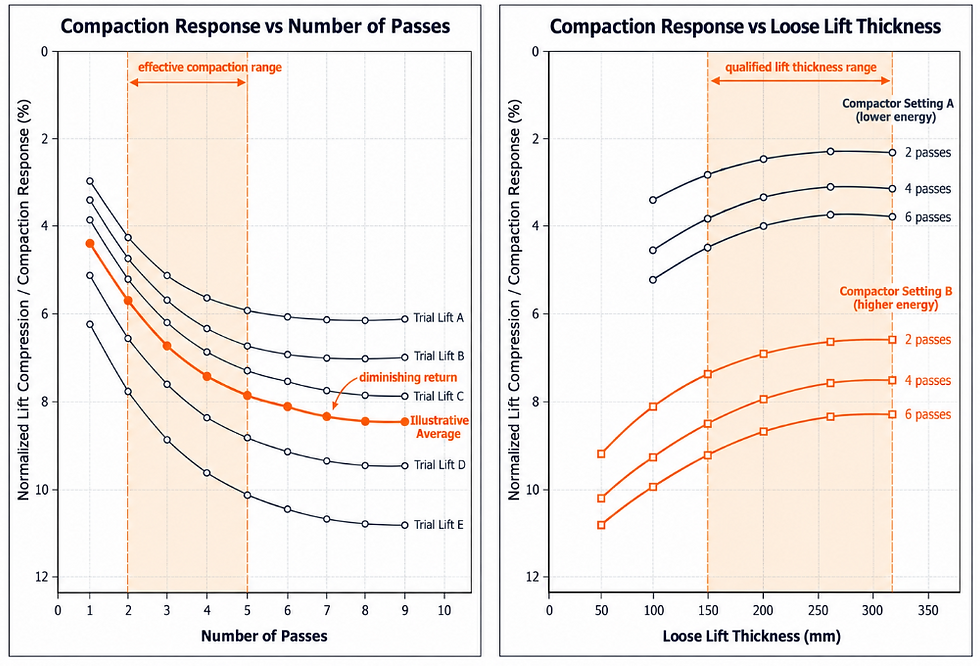
A lunar trial section could establish the relationship between material type, loose lift thickness, compactor settings, number of passes, and the resulting density, penetration resistance, stiffness, and final geometry. Once that response becomes stable and repeatable, it can form the basis of the production procedure.
This is particularly important for berms, haul roads, shielding fills, and foundation pads. These features will probably be built in successive lifts. If the lift is too thick, the upper part may densify while the lower part remains loose. If it is too thin, construction becomes unnecessarily slow. If the vibration setting is too aggressive, the machine may lose efficient contact with the ground or disturb material already placed.
The practical construction challenge is therefore not simply how many passes are required. It is how many passes are required for a given material, lift thickness, machine setting, and operating condition to produce an acceptable layer through its full depth.
Something like: Material + lift thickness + placement method + compactor settings + number of passes = qualified construction process
That process should also include grading and tolerance control. A haul road needs more than adequate density; it needs line, grade, crossfall, and surface regularity. A foundation pad needs the correct elevation and a uniform bearing surface. A berm needs the specified crest width, slope geometry, and placed thickness. Those requirements belong to the same construction sequence as compaction.
The production method should also define what happens when the result is outside the acceptable range. Additional passes may be sufficient in some cases. In others, the material may need to be scarified, regraded, reprocessed, or replaced. That is the point where compaction becomes more than a machine capability; it becomes a controlled earthwork operation.
Does a Vibratory Roller Behave the Same Way on the Moon?
Vibratory compaction is an obvious candidate for lunar earthworks because it is already widely used for granular fills on Earth. The basic mechanism is straightforward. A rotating eccentric mass generates cyclic force, the drum transmits that force into the ground, and repeated loading helps particles rearrange into a denser configuration. The complication is that the Moon changes the drum–ground interaction.
The vibration mechanism itself can operate in a vacuum, provided the machine is designed to handle the thermal, lubrication, sealing, and materials issues that come with that environment. The more difficult challenge is how effectively the vibration transfers into the regolith under one-sixth gravity.
A terrestrial vibratory roller relies on both its static weight and its dynamic excitation. On the Moon, the same machine mass provides only about one-sixth of the static weight. That reduces the normal force at the drum, the available traction, and the preload that keeps the drum coupled to the ground. This does not mean vibratory compaction will not work. It means that direct scaling from terrestrial equipment is not enough. If the dynamic force becomes large relative to the available static or imposed load, the drum may begin to unload or bounce rather than transfer energy efficiently through the full lift. Increasing vibration amplitude is therefore not automatically beneficial. A larger dynamic force may improve particle rearrangement up to a point, but beyond that it can increase machine motion without producing deeper or more uniform compaction.
The ground itself is also operating under a very different stress regime. Near the lunar surface, overburden confinement is extremely low because gravity is low. This affects particle contacts, dilation, shear response, and how vibratory energy propagates through the fill. A vacuum chamber on Earth reproduces the atmosphere, but it does not reproduce the lunar gravity field or the associated stress state. Therefore, a lunar roller design may need to rely more on controlled downforce than on machine self-weight alone. That downforce could potentially come from the carrier, suspension system, articulated structure, or another reaction mechanism.
The optimum arrangement will depend on the type of fill, the required treatment depth, and the geometry being constructed.
This also affects production on slopes and grades. A compactor working on a berm face, ramp, or haul road needs sufficient traction while maintaining consistent drum contact. Low gravity reduces both the normal force and the available frictional resistance, so speed control and machine stability become part of the compaction problem.
Before moving into production, compaction practice is usually established through a trial fill or test section using representative material and equipment. The purpose is to determine how the placed material responds to lift thickness, compactive effort, and repeated passes, and to identify the point at which additional effort produces little further improvement. For reworked lunar regolith, the same approach would provide a practical basis for setting lift thickness, pass count, and operating parameters before those requirements are carried into berms, haul roads, foundation pads, trench backfill, or shielding works (Figure 1)
For construction, the key issue is not whether the drum can vibrate. It is whether the equipment can deliver a controlled amount of compactive energy into the placed material, through the required lift thickness, without losing effective contact with the ground.
That relationship needs to be demonstrated before a terrestrial vibratory-compaction concept can be confidently scaled into a lunar production system.
"Compacted" Means Different Things for Different Lunar Assets
There is unlikely to be one universal lunar compaction criterion because the required ground condition depends on what the earthwork is expected to do.
A haul road, a reactor foundation, a berm, and trench backfill may all use reworked regolith, but they have different performance requirements. The compaction process must therefore be linked to the asset's function.
For an access haul road, the main concerns are repeated trafficking, rutting, shear deformation, surface regularity, and maintainable grades. A very high density may be unnecessary if the road already provides adequate stiffness and trafficability. The more useful acceptance criteria may combine layer thickness, surface tolerance, penetration or stiffness response, and proof trafficking.
Let's have a look at some surface assets' minimum requirements:
For a nuclear reactor foundation or equipment pad, the requirements are more demanding. Total settlement, differential settlement, stiffness uniformity, bearing response, and final elevation become important. Local soft zones that might be tolerable beneath a haul road could be unacceptable beneath a critical foundation. The compacted fill may also form part of the load-transfer system between the foundation and the underlying regolith, so uniformity through the full treated depth becomes important.
A tall solar tower introduces similar concerns, but with greater sensitivity to differential movement and overturning. Small differences in foundation response may translate into significant movement at the top of the structure. For that type of asset, compaction would need to be considered together with foundation geometry, anchorage, allowable rotation, and construction tolerances.
A protective berm is different again. Its performance depends on lift placement, overall geometry, crest width, side slopes, internal stability, and the ability to retain its shape. Poor lift control or segregation could create weak horizons even if average density appears acceptable.
For cable trenches and utility backfill, the focus shifts to bedding, support around the installed system, controlled backfill thickness, settlement, and final cover. The material immediately around a cable or conduit may need different handling from the bulk backfill above it. Excessive compactive effort close to an installed asset may also be undesirable.
Large regolith shielding works introduce yet another set of controls. These may involve substantial volumes of excavated and rehandled material placed around, against, or above structures. Production rate, lift sequencing, geometry, slope stability, total thickness, and load imposed on the protected structure may govern the work as much as density.
In other words, the same compactor could potentially be used across some of these applications, but the acceptance state should not be the same.
That is why a statement such as “85% relative density achieved” has limited value unless it is tied to the intended use of the fill. The required level of compaction should come from the performance needs of the asset and the consequences of movement or loss of support.
In practice, lunar earthworks will probably need different material classes, placement procedures, and acceptance criteria for different construction functions.
From Roller Passes to Verification and Ground Acceptance
As you noted, compaction is complete only when the treated ground has been checked and accepted. On projects, the roller is part of a wider quality-control process. The field team tracks where the equipment has worked, how many passes were completed, whether the material was placed within the specified lift thickness, and whether the resulting ground response meets the project requirements. When needed, point testing confirms conditions through the compacted layer.
A robotic compactor may eventually record its own operating data continuously. Position, pass count, travel speed, vibration settings, and machine response can all be georeferenced. That creates the basis for an as-built compaction record rather than relying only on isolated measurements taken after the work is complete.
The industry is already moving in this direction through intelligent compaction. Modern rollers can produce coverage maps and pass-response records that show where the ground has received adequate treatment and where the response remains inconsistent. Lunar construction should adopt that approach from the outset.
Modern intelligent-compaction practice looks at how the ground response develops from one pass to the next, rather than treating pass count as the acceptance criterion by itself. The early passes usually produce the largest change, followed by a progressively smaller gain as the material approaches a stable condition (Figure 2). Tracking that response helps define an efficient production range and identifies areas where additional rolling may no longer provide meaningful improvement. For lunar earthworks, this approah could be particularly useful where power, operating time, and equipment life are limited.

The most useful control is not simply the number of passes. It is the change in ground response with each pass. If the material reaches a stable response after five or six passes, additional rolling may add little value. If the response remains low or highly variable, the problem may lie in the material, lift thickness, underlying ground, or operating settings. Depth also has to be verified. A dense surface does not prove that the full lift has been improved. This is particularly important where surface measurements are stronger than core or penetration results at depth. For engineered fill, the acceptance condition should represent the treated volume, not only the upper few centimeters.
A lunar QA/QC system will therefore need a combination of continuous machine data and targeted ground verification. Depending on the application, this could include penetration resistance, stiffness, density, proof loading, or another calibrated mechanical response. The work should also be divided into defined construction lots or areas. Each area can then be classified as accepted, requiring additional passes, requiring rework, or needing engineering review. That provides a practical way to manage variability without expecting perfectly uniform regolith.
Nonconformance needs to be part of the process from the beginning. Some areas will not meet the target on the first attempt. The response may be additional compaction, reduced lift thickness, scarification and recompaction, material reprocessing, or removal and replacement. The important point is that the response is defined before production starts. Final acceptance also includes geometry. A haul road still has to meet its required grade and crossfall. A foundation pad has to be at the correct elevation and within the required surface tolerance. A berm must meet its specified profile. Compaction quality and geometric compliance belong to the same construction record.
Surface density alone does not confirm that the full lift has been improved. Compaction influence normally decreases with depth, and additional passes may increase both the magnitude and depth of the response (Figure 3). For lunar earthworks, this means that lift thickness must be matched to the effective treatment depth of the compactor and confirmed through field trials and targeted verification.

The result should be a georeferenced as-built record showing what was placed, how it was compacted, how it responded, where verification was carried out, and whether the completed area was accepted. That is the point where a compacted layer becomes an engineered earthwork, the roller completes the operation, and verification releases the ground for the next activity.
Once compaction moves into production, the work needs to be controlled spatially rather than by isolated test points alone. Intelligent-compaction practice already uses georeferenced pass counts and response measurements to identify uniform areas, weak zones, and locations requiring additional treatment. Figure 4 shows how it could be applied for lunar earthworks; the same approach could support autonomous QA/QC by turning every compactor pass into part of the construction record and clearly separating accepted ground from areas requiring rework or further investigation.

Technology Readiness is Not Construction Readiness
The compaction hardware can mature faster than the construction process around it. That is not unusual, because a machine may demonstrate reliable operation, survive the relevant environment, integrate with a rover, and achieve repeatable densification in test materials. Those are legitimate technology milestones.
Construction readiness asks for something different.
The process needs to define the material envelope, lift thickness, operating window, treatment depth, verification method, tolerances, production controls, and acceptance criteria. Those elements determine whether the equipment can be used repeatedly and predictably on an actual project. For instance, a compactor may approach TRL 6 while the earthworks process it supports remains much less mature. The hardware may be ready for system-level demonstration; on the other hand, the construction team may still lack a qualified method for deciding how material is placed, how many passes are required, how deep the improvement extends, or when the completed ground can be released for the next activity.
That maturity gap can create problems later simply because if the construction requirements are defined only after the equipment architecture is largely fixed, the machine may need additional downforce, different vibration settings, deeper sensing, better grading control, or another means of verifying the ground. Those changes are much easier to accommodate early than after mass, power, structure, thermal control, and interfaces have been locked.
Technology development should continue to improve the compactor itself. In parallel, the construction process should establish the material classes, test sections, lift criteria, performance thresholds, QA/QC procedures, and sign-off requirements needed for production work.
That is where construction experience becomes valuable. The objective is not to slow technology development, but to make sure that the machine being matured can eventually operate inside a defined and auditable construction system.
For lunar earthworks, “compacted” should ultimately mean more than a measured increase in density after several passes. It should describe a ground condition that has been specified for a particular use, produced through a qualified method, verified through the required depth, built within tolerance, and formally accepted.
The Moon does not just need a compactor. It needs a practice for engineered ground.
Source Base
NASA/Lunar Surface Innovation Consortium (LSIC) - PACT and STOMP Regolith Compaction Presentation, 2026.
NASA. Apollo 16 Preliminary Science Report, NASA SP-315, 1972.
NASA. Apollo 17 Preliminary Science Report, NASA SP-330, 1973.
Heiken, G.H., Vaniman, D.T., and French, B.M., eds. Lunar Sourcebook: A User’s Guide to the Moon. Cambridge University Press, 1991.
ASTM International. Quality Control of Soil Compaction Using ASTM Standards, Manual 70, 2011. DOI: 10.1520/MNL70-EB.
Shanklin, D.W., Rademacher, K.R., and Talbot, J.R., eds. Constructing and Controlling Compaction of Earth Fills, ASTM STP 1384, 2000. DOI: 10.1520/STP1384-EB.
FHWA. Intelligent Compaction Measurement Values (ICMV), FHWA-HIF-17-046, 2017.
FHWA. Utilizing Intelligent Compaction to Ensure Quality and Uniformity of Pavement Foundation, FHWA-HIF-24-097, 2024.
FHWA. Intelligent Compaction — Every Day Counts.
Fellin, W., and Kolymbas, D., eds. Compaction of Soils, Granulates and Powders. CRC Press/Balkema, 2000.
U.S. Army Corps of Engineers - earthwork and compaction guidance.
NASA. Technology Readiness Level definitions.
Roberto Moraes
Luncar Construction Strategist | SpaceGeotech | Author



Comments